7 Reasons Why Bad Website Design Decisions Get Made

I cam across this great post on why bad website design decisions get made (published on the Tribute Media website).

Of the 7 points that are made there is a common theme that runs through them all.

In far too many cases the decisions that are made about the best design are too focused on what the organisation would like to achieve rather than what the visitors to your website are there for in the first place.

This is a result of the focus being in the wrong place – too much time is spent on coming up with a website design that gets the approval of the powers that be. The damaging effect of this is to further disconnect your website from the people who will be using it.

At the very outset of your website design journey you should be spending a lot of time researching who it is that visits your website and what they want to do when they get there.

7 Reasons Why Bad Website Design Decisions Get Made.
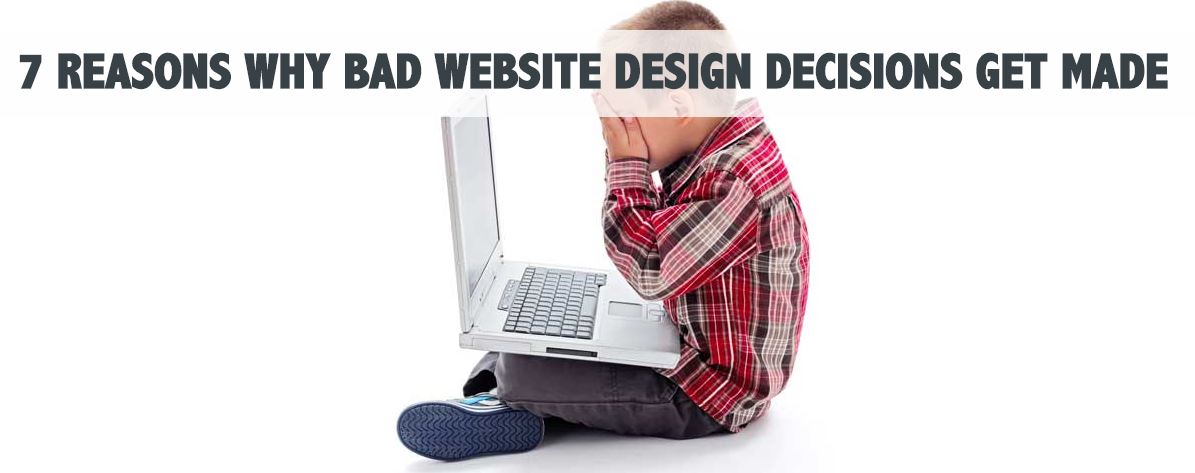
why bad website design decisions are made

7 reasons why bad website design decisions get made – original post from Tribute Media

All of this information is very easy to get:

Have a look at your current website analytics – there is a wealth of information in here about current user behaviour. Where are your users coming from? What content is most popular? Where are your poorly performing pages?

in addition to this you should be profiling your different website users – creating personas for the people who visit your website is a very useful exercise that will allow you to better understand how to deliver a positive website experience for your visitors.

This can be easily achieved by talking to the customer facing people within your organisation. Your sales team is the obvious first step but don’t ignore the others in your organisation that can add some serious value to this process.

If you discover that you are selling to procurement departments, then involve your own in this profiling exercise as you’ll often find that what is important to them gives you an insight into what motivates your customers’ buying decisions.

The same is true if you find that you are selling to accountants – increasingly it is accountants who occupy the Managing Director or CEO position. Involving your own Finance Director or CFO will allow you to expand your awareness of what questions these people are likely to want answered when considering buying a product like yours.

It is this focus on your visitors that will allow you to create a website that will ultimately deliver you increased conversions – whatever that conversion may be. It could be increased sales, increased white paper or brochure downloads, increased enquiry levels, increased registrations for the event you are running, increased donations for your charitable cause.

Whatever sector you are operating in – public, private or third sector – the process should be the same.

In my experience a lot of the conflict and pain of a new website design project is as a result of a misplaced focus on the subjective elements of the website design.

It is virtually impossible to get a cross section of people to agree on a design that they all like – we all prefer different websites for different reasons. When your project uses consensus on the design of your new site as the starting point or your project it is destined to take longer than you originally planned for, cost more than you originally planned for and – most importantly – deliver a website that it not configured to achieve its objectives for improving business results.

Your website is not a vanity project – it’s a project that when delivered correctly will deliver real, tangible, positive results for your company or organisation. But only if you get back to the science of the process and remove subjective decision making.

7 Reasons Why Bad Website Design Decisions Get Made.

If you would like some help with your website project then get in touch:

Go back

Your message has been sent

Warning
Warning
Warning
Warning

Warning.

6 web development misconceptions of CEO’s

website design pic

Your website project needs careful consideration

An recent article on the Entrepreneur website outlined 6 common misconceptions that CEO’s have about web development.

The article was written by Zach Ferres and while I agree with some of the points he makes there are some others that I think merit a little more discussion.

I think the article starts off on the right note:

Remember the last website project you were involved with – the one that went over budget and missed all the project deadlines that were agreed at the outset – was most likely your fault (by using the term ‘your’ I’m assuming that you were part of the marketing department that was in charge of leading the project within your organisation).

There is no doubt that most website projects are a lot more painful than they need to be. It really is very simple – and with some forward planning and a better understanding of what it is that you are trying to deliver you can avoid all of this pain.

One of the best lines I’ve ever read about web development projects came from a guy at a company called Fathom in Belfast – he said ‘It’s entirely possible for a website to be pretty and pretty awful at the same time.’

Why does this happen? Because too many web development projects are built around what we (the organisation) want to talk about rather than what our customers are actually looking for. I’ve written another post on this very subject called ‘Your website – for you or your customers?’

Anyway, back to the 6 misconceptions that CEO’s have about web development:

1 – Website development is easy

I agree with Zach Ferres here – those not directly involved in the project have very little appreciation for how long the ‘under the bonnet’ development work actually takes. Our role as project leaders for the web development project is to try and build this understanding – break down the project plan into the relevant phases that your development company has given you and highlight the time devoted to the development work.

This is difficult because most CEO’s, other board members and other people in your organisation are just dying to see the big reveal of your new home page design. They care very little about the journey planning element of the website architecture which is essential if the website is going to perform to maximum potential.

My advice – involve them in this stage. Get them involved in understanding who it is that is visiting the site and what they are trying to achieve when they get there. This will help to build an evidence based argument about what content should be on the site and where it should live.

2 – Everyone should be involved

In the original post Zach Ferres believes that the project should only be left to the people doing the work – I’m afraid I disagree. I’ve seen too many website projects fail because the project didn’t have the buy in of people across the organisation.

I believe it’s wrong to assume that only marketing will know what people are looking for when they visit your website – this is not a marketing project.

Your website is a project that should involve as broad a cross-section of people and opinions as you can muster. All of this work should be done at the outset and once all of the intelligence has been gathered then the build process will come together a lot more quickly than without these essential steps.

You will also find the because buy-in now exists across the organisation the final website will be much better received internally when your launch date arrives. This is because the decisions about how to categorise information, how to present information, what calls to action to include were all taken by your development group and were based on evidence.

This avoids subjective opinions on colours, button sizes and the location of information being used as the basis on which people judge your website. The only judging criteria worth considering is the user experience on your website and ultimately the results that it delivers for your business.

3 – Websites are a commodity

I am fully behind Zach on this one – if you want to use free website build templates for your website project you’ve got to accept their limitations. The more customisation you want to be able to introduce to your website, the more likely it is that a custom build is the route you are going to have to take.

4 – Once a site is built it’s done

Your website project doesn’t have a completion date – the end of the development project is marked by your ‘go live’ date. This is only the beginning of the journey to turn your website into a pipeline stuffing machine (or whatever your stated objective is from the website).

5 – Anyone can create a great user experience

While Zach Ferres disagrees with this statement in the original post I’m actually inclined to support the view that anyone can create a great user experience on their website.

The problem is that most people don’t.

But the reason why they don’t is (in my humble opinion) a result of the process that is followed during the web development project.

Too many projects jump straight into defining the various menu options and then deciding what information to house in these silos. Then the marketing department starts writing copy (largely with the aim of hitting all the required keywords).

And all of this is done with no consideration for who will be visiting the site.

Before a line of code is written, a menu option decided on or a word of copy written you need to go right back to the start.

  • Who is it that visits your website?
  • What are they looking for when they get there?
  • How did they get there in the first place?
  • What other sites have they been on before they got to yours?
  • Is this the first time they’ve been to your site or are they a repeat visitor?

Doing an internal workshop with the people in your organisation who interact with customers most regularly will give you some great insights into what content you actually need to look at for your new website.

You can then validate this information by asking some of your customers whether your assumptions are right. This is extremely powerful – it takes the guesswork out of the exercise and gives you confidence, even during the build process that you are building something that will deliver better results for your business.

This is a very simple process – anyone who knows about your business can contribute whether they’ve built a website before or not.

6 – It’s your website so you dictate the design

I’m back to agreeing with Zach again on this one – there are web designers with much better knowledge of what works in relation to web design than you. They will make sure your site follows best practice guidelines which will maximise the potential for your website to deliver for your business.

Once again, ask yourself the question – is your website for you or your customers?

No project should be signed off until it has been tested with real users and feedback taken and acted upon to improve the site experience.

Thanks to Zach Ferres for the original post. I hope you find these observations useful.

If you’re working on a website development project and you’d like some help then get in touch.

Go back

Your message has been sent

Warning
Warning
Warning
Warning

Warning.


Your new website – for you or your customers?

website design and planning

Your website is stage 1 in your sales process

So you’re embarking on a new website project?

It might be over simplifying it but when it comes to developing a website you’ve got 2 choices.

Option 1:
Develop a website that is designed to tell your customers everything that you want them to know.

Option 2:
Develop a website that answers the questions that your customers want answered and shows them how you can help them solve whatever problem it is that they currently have.

When does a bad project start to go off track?

Right at the very start. People start selecting the images they’d like to use and writing thousands of words under the generic menu headings:

  • About us
  • Our team
  • Products / services
  • Contact us
  • Recruitment

All of this work usually begins without a single question being asked about who it is that visits your website and what they want when they get there.

There could be multiple different visitor types. No – there are multiple different visitor types.

  • Existing customers
  • Potential customers
  • Job seekers
  • The bank you’ve just applied for a loan from
  • Funding bodies
  • Suppliers
  • Potential suppliers

Before a word of copy is written, a line of code is created, a minute of design is spent you need to

  1. Understand who it is that is visiting your site
  2. Prioritise your visitors – who is most important to you?
  3. Understand what they’re trying to achieve when they get there
  4. Know what message you want to give them
  5. Know what you want the end result of their visit to be – what’s a conversion?

Once you’ve done all of this you’ll be in a far better position to

  1. Create the engaging content that gives them what they’re looking for
  2. Understand what navigation options suit best
  3. Start the design process with objective research as the driving force rather than subjective views on images, button sizes and design schemes

All of this combines to maximise the potential for you to convert your website visitors into qualified sales leads.

You wouldn’t forgive a salesman for selling nothing on the basis that he looked the part.

Treat your website the same way – yes, it needs to look professional and reflect the culture of your company but it’s far more important than that.

It’s step 1 in your sales process.

If you’re looking for some help with your new website project then get in touch and we’ll put the plan into action.

Go back

Your message has been sent

Warning
Warning
Warning
Warning

Warning.