
It seems that everyone is searching for the silver bullet that will allow them to create viral campaigns at will. I think this is a problem.
The endless focus on viral and how it can be achieved suggests to me that there is a misconception that a viral campaign is the single key performance indicator that matters. The suggestion here is that viral automatically equals success. While there is no doubt that this is the case in some instances I think there are more than enough examples of viral campaigns that simply haven’t worked – they haven’t delivered any significant business result.
I’ll illustrate this by looking at examples of 2 viral campaigns – both of which would have been described as successful if the only measure was whether they achieved the ‘viral’ badge of honour.
One of the best examples of a successful viral campaign is the ongoing campaign run by Blendtec to promote the blenders that they produce. This is one of the most often quoted examples of successful viral campaigns and it’s easy to see why. They didn’t just create one video that went viral – they’ve managed to sustain their success over a reasonably long period of time (digital years, as we all know are like dog years in fast forward).
Their video showing the blending of an iPad using a Blendtec blender has to date had almost 17 ½ million views on their Youtube channel. The iPhone in the blender has had 12 ¼ million views. Other products that have had the Blendtec treatment include golf balls, crowbars, magnets and marbles.
You can watch all of the Blendtec videos on their Youtube channel – https://www.youtube.com/user/Blendtec
So why did it work?
The Blendtec story has so many factors that made it successful – the first video that went viral was simply the delivery mechanism for the campaign.
First of all, they have a great product – the rationale for putting all this weird and wonderful stuff through a blender was to demonstrate the strength of the blender. If it can blend an iPad or a golf ball it’s going to have no problem making your breakfast smoothie. So the campaign had a clear purpose – demonstrate one of the key unique selling points of the product.
Secondly, it’s a mass market product. Achieving almost 30 million views for the iPad and iPhone videos is a step in the right direction for Blendtec in making their product more well known and more desirable. The potential for people to decide to buy a Blendtec blender is almost beyond comprehension – it’s not inconceivable that every home in the world could have a Blendtec blender.
The key thing that determines whether the Blendtec campaign was a success is the difference it made to their sales numbers. The results here are astounding – in 2009 it was reported that after the first 186 videos sales were up 700%.
All of this was possible because the campaign had a clear purpose and a solid business behind it.
You can read a case study of the Blendtec story at http://www.socialens.com/wp-content/uploads/2009/04/20090127_case_blendtec11.pdf
This is a viral campaign that worked – not because it went viral but because it delivered a significant business result.
Equally, there are mass market brands that try and run viral campaigns that aren’t as successful. One of the best to illustrate the point that viral alone doesn’t mean success was done by Kodak back in 2007.
In the absence of the video you can read an online article detailing the success of the campaign at http://adage.com/article/digital/kodak-s-deprecating-house-video-viral/114076/
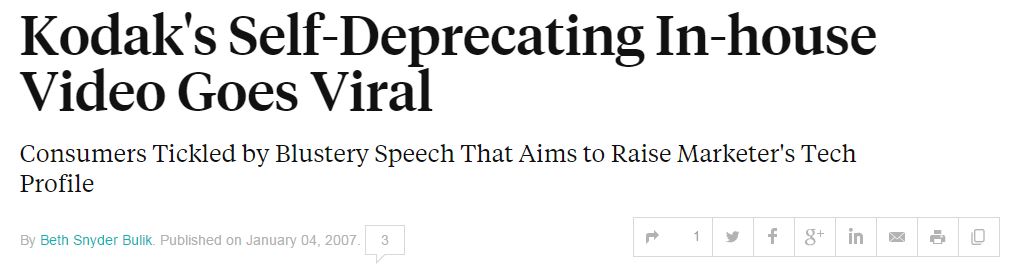
Headline from a Adage article on the famous Kodak viral campaign
This video sought to address the perception that Kodak was a tired old brand that had been left behind by the digital photography boom. They had failed to spot the changing demands of their customers and they tackled this issue head on with the launch of a video which was very self deprecating – admitting all the mistakes of the past and recent present but promising that it was all about to change.
Personally, this was one of the best videos that I ever watched online – but despite numerous searches it’s just not available any more. Why? Because in 2009 the company went out of business.
While the campaign achieved the objective of going viral it didn’t make one blind bit of difference to the prospects for the company. Why? Because viral isn’t a healthy objective to have for any campaign.
The Kodak campaign was destined to fail because it had no purpose other than going viral, no substance to back up the claims they made in their video. They may have talked about embracing the digital revolution and to watch out for all the new technology that they were about to unleash on the market. But the fact was that they didn’t have any of this. It was an elaborate cover story to try and buy some time.
I bet when the Kodak video went viral the agency involved and the Kodak marketing team were busy patting themselves on the back about what a wonderful job they had just done. For them, the viral video was evidence of success. The proof that this has no foundation is what happened to Kodak in 2009 when they closed their doors.
I think these two campaigns represent the 2 extremes of viral campaigns.
Blendtec is a great sales, marketing and product development story that demonstrates the value in understanding your customers, understanding your product and having a clear objective for your campaigns.
Kodak is an example of viral for the sake of viral. That’s as much substance as there was. Was it clever? Yes. Was it funny? Yes. Did it reach a massive audience? Yes. Did it work? No.
What this says for me in that in the midst of this technological age success in sales, marketing and business in general is still down to a few good old fashioned things:
A great product, in the right market, at the right price, delivered through the best sales channel with superior customer support and a great sales team.
Get these basics right and your success will be long term and tangible rather than a flash in the pan viral campaign.
I’m reminded here of a previous post on this blog, the title of which seems very relevant. Consistency is far better than rare moments of greatness.


 Petrac Marketing