
Urgency as the key ingredient in successful marketing strategy execution

I love targets. They help to define what success looks like but I think there’s a much more valuable function that they perform.

Put simply, the create clarity amongst the noise that our everyday marketing work creates.

We all have so much going on – the event you’re planning, the last minute requests for ad copy from your print and digital media campaigns, the case study you have to write, the product launch piece you need to sign off, the photo shoot for your latest project.

Having a set of clearly defined targets helps to create order from this chaos and allows you to take a look back over your activity and see what impact it is having – how it is contributing to your journey towards delivering on all your key metrics.

But it’s not simply the value of targets that I want to talk about. What I’d like to look at is how we use these targets to drive better performance. While defining the key metrics is a crucial part of this it’s only the first stage in a successful process.

It’s my experience that unless appropriate attention is given to what the evaluation and reporting process looks like the time spent setting targets is wasted time.
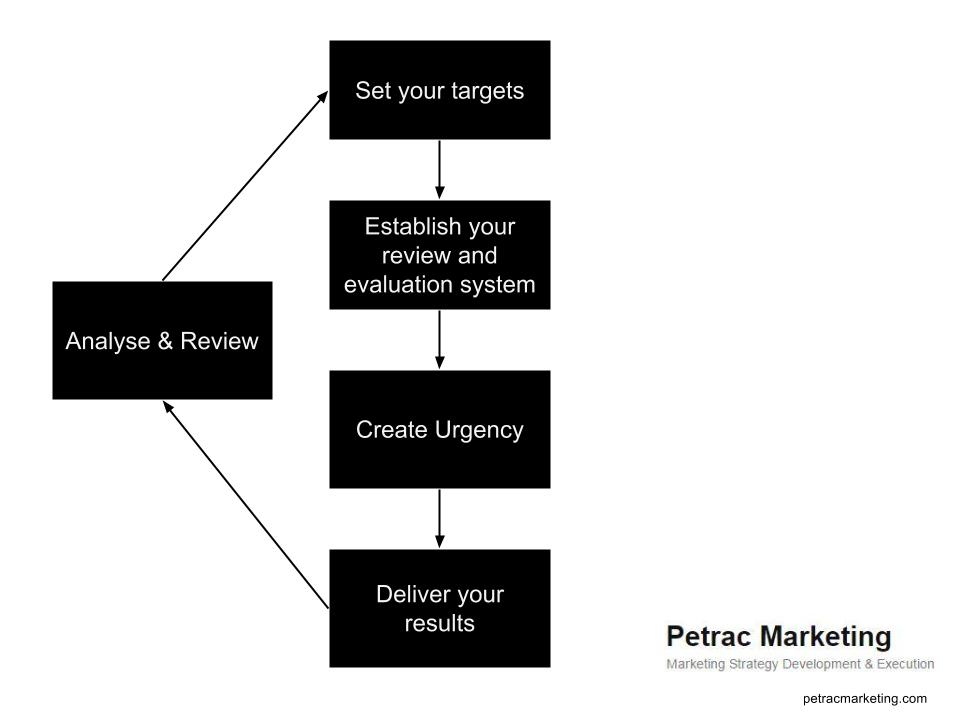
Strategy execution sales and marketing by petrac marketing

Urgency is the key ingredient in your sales and marketing strategy

Simply setting your targets is not a job in itself. It is merely an exercise that ensures you will be able to deliver value from your sales & marketing strategy.

In setting up your evaluation and review process there are a variety of issues that need to be addressed and questions that need to be asked.

How often do you review progress against your targets?

The answer to this will be inextricably linked to the sector that you are in. If you’re involved in the fast moving consumer goods sector then it’s not inconceivable that there are daily targets to be reviewed. In the B2B market this review process will usually not be as frequent.

I’ve spent a lot of time in the high value capital equipment market – focusing on the quarrying and mining equipment market. In this, and other high value capex project markets the gestation period for new sales can be very long. As a result, businesses are typically set up for quarterly reporting.

This cascades down to the sales and marketing teams charged with delivering the new sales.

We recently did a bit of analysis of new sales won by month rather than by quarter and the results were very interesting.

In each of the last 3 years the best four months sales figures were in the final month in the quarter. Even more interestingly this remained the case even when the business changed its reporting period with HMRC.

What this suggests is that the pressure to perform, the pressure to deliver the sales target created an urgency across the business. This urgency was seeming to create the environment where our sales team were able to remove all the barriers to purchase that had been in place for the previous 2 months.

So what did we do about this?

The conversations centred around how we could ensure that the sense of urgency from the last month in the quarter was present every month.

If we could do this we would smooth out the dreaded lumps in our new order ledger. This would improve cash flow across the business and ensure that investment planning decisions could be made more comfortably.

What we did was not only extremely effective – but frighteningly simple.

We moved from a quarterly reporting system to a monthly system. The sales and marketing teams had their targets redrawn to show 12 individual monthly targets. This was linked to new commission plans and bonus schemes.

The annual target was no longer one large number but twelve smaller numbers. This helped to create a new environment where a sense of urgency was present every day across every member of the sales team.

Supporting departments providing technical specifications, preparing customer proposals, finalising payment terms were all incentivised the same way to ensure that everyone was working together to deliver the common goal – the new sales at the right margin that would deliver further growth and provide the financial basis on which future growth plans were founded.

The urgency is created by the fact that the maximum amount of time left for you to deliver your next target is 30 days. This led to a considerable development in expertise within the sales and marketing team. Sales and marketing craft developed at breakneck speed because there was now a requirement to understand the customer, understand the obstacles to the deal being done, understand the competition better than they understand themselves.

What were the results?

It won’t come as a surprise that the new strategy and reporting / reward scheme took a large amount of internal selling before it was introduced.

It won’t come as a surprise that it took a while before it started delivering the intended results – but only a short while. After a slow first three months by month 4 the intended results started coming through.

Another important factor is company culture. This system creates a pressure environment. Your people need to thrive in this environment.

This system also requires that sales and marketing does not operate in a silo but that the organisation as a whole recognises the importance of new sales and works in partnership with them to help bring the new sales in.

For me it’s the perfect example of the science of selling and how an understanding of what drives people to succeed will help your business to deliver better results.

If you would like some help with any aspect of your strategy setting or review process then get in touch.

Go back

Your message has been sent

Warning
Warning
Warning
Warning

Warning.

Keep it simple. Keep it human.

there is beauty in simplicity

Simple marketing messages connect with your customers

Some believe that the more complex you can make something sound, the more intelligent you will assume the designer is.

If the years I have spent in the manufacturing sector has taught me anything it is to focus on the simplicity of it all.

This doesn’t mean the product was simple to design – quite the opposite. In crafting the marketing message to accompany the shiny new product just focus on the end result for your customer.

Does it reduce their workload?

Does it reduce their costs?

Does it make their life a little easier?

Does it reduce waste or make their business more efficient in some way?

This is where the magic is found in your customers’ eyes.

It’s not about the clever piece of software you’ve created or the engineering of your new machine.

It’s about the problems that you are solving for your customers.

It’s about demonstrating that you understand their business, understand their daily frustrations and understand the value in being able to solve their problems.

It’s this approach that leads to true partnerships with your customers.

It then becomes a self fulfilling prophecy – you get even greater access to their business, which fosters an even greater understanding of their requirements.

All of this builds over time to create relationships that are very hard to break. The value you are adding now extends way beyond the product or service you are offering.

In the pyramid of trust a sales person appears very close to the bottom. This approach will help you move yourself out of this area and into the ‘expert’ zone.

And it all starts with a simple marketing message.

If you would like some help with a new product launch or to define your business to a new customer group or new market then get in touch.

Go back

Your message has been sent

Warning
Warning
Warning
Warning

Warning.

Consistency is far better than rare moments of greatness

Chess board represents marketing strategy

Random moves lead to defeat – strategy is what is required to win

I love this line – the title of a book by Scott Ginsberg from 2012.

For me it sums up what marketing is all about. While others may judge us on the impact of an individual event, video etc we should be judged on consistently delivering results that will allow our businesses to achieve their goals.

It is far too often the case that marketing is judged on the tactics employed rather than the overall results – and this is because of a disconnect between the overall business strategy and the marketing activities that we are engaged in.

Rare moments of greatness happen by accident rather than design. They happen because we’re just trying to do a lot of different stuff with the digital channels available to us without proper consideration for what we’re trying to achieve or what success looks like. It’s inevitable that the more we do of this stuff, the more we learn about what works and the better we get at spotting content that is likely to get a good reaction online.

And this is part of the problem – an endless pursuit of Facebook likes does not constitute a strategy. It is merely a tactic to help you deliver something valuable. So what is it that you’re trying to deliver? The problem is that a lot of people just don’t know.

To move from rare moments of greatness to the consistency that will deliver real business value you need to take a step back – ignore all the tools you have available to you and focus on what it is you are trying to achieve.

The first step is to understand what your goals are – this is derived from your overall business strategy. This could be to win a certain amount of new sales / donations within a new sector or market or increase market share to give some examples.

From this we are then able to define what the goals of our marketing efforts are:

Are we trying to drive traffic to our website or blog because we know this generates more leads?

Are we trying to provide resources and information to assist our customers with their buying decision?

Are we trying to build a social following to build our reputation in the industry?

Once you know what it is that you’re trying to achieve you then need to know how you’re going to measure success.

If we’re trying to drive traffic to the website to generate more leads – how much traffic do we need and how many leads should this convert to?

If we’re trying to provide resources and information to assist customers with their buying decision – how many downloads of the whitepapers, brochures and case studies are we looking for?

If we’re trying to build a social following – how many new likes or followers are we trying to win? Or maybe focus on the engagement metrics instead – the conversations that begin because we started them, the number of times our content was shared?

When you have these things in place you can then start thinking about the tactics that you’re going to employ to help you achieve your goals. It’s only now that the channels come into the equation – where do your target audience hang out, what is the best way to connect with them when they are there and what content will they find either useful or interesting? This should include both online and offline channels to deliver the best results.

A well considered digital strategy will yield results for your business – simply because you now know what you are trying to achieve.

This will allow you to quickly and easily report on progress internally and demonstrate to the cynics in your organisation the value you are adding through your digital content marketing activity. This focus on performance is what is all too often missing from the marketing function.

Too many KPI documents for the marketing department are littered full of tactics that shift and change depending on the latest requests from the board or the sales team. All this does is measure activity – and just because you’re busy doesn’t mean you’re adding any value.

By stepping back and considering what it is that we are trying to deliver we can shift the focus from the activity to the value that we are adding and this is when we will achieve consistency.

Because consistency is far better than rare moments of greatness.

If you would like some help either developing your digital marketing strategy or deploying the tactics to ensure success then get in touch.

Go back

Your message has been sent

Warning
Warning
Warning
Warning

Warning.

Need convinced about content marketing? Read this.

I came across a great blog post today from @captora with some really powerful stats on the rise of content marketing in recent years.

There is no doubt that the stats are convincing – content marketing is here to stay and I don’t think you’ll get much of an argument from any modern marketers.

So here’s my problem – if my hypothesis is correct and there is an acceptance that content marketing needs to be central to any marketing strategy there must be something else that is stopping people from getting involved.

I think there is a general fear of content marketing – largely driven by the fact that it is often accompanied by the word ‘strategy’. This immediately conjures up visions of 100 page documents and puts people right off.

So, to try and dispel this fear I’ve taken two of the key stats from the @captora post and asked 2 important questions:

  1. What does this mean for your company?
  2. What can you do about it?

Here we go:

Stat #1:
There are 27 million pieces of content shared each day online

What does this mean for your company?

This is one hell of a big number – you need to understand how much of this content relates to your industry, to the products you are selling. This will vary hugely depending on whether you’re involved in a mass market consumer product or a niche engineering application for example.

What can you do about it?

  1. Understand what your goal is – what does success look like? Sales, website visitors, video views, increased followers, more enquiries?
  2. Two ears, one mouth – use them in that proportion.
  3. Search online for content relating to your industry (Google Alerts are a great way to do this).
  4. Search Twitter to see who in your industry is doing this stuff well – and understand why.
  5. Once you’ve done this initial research you will better understand what content you can produce that is suitable for sharing, likely to get a response and will ultimately lead to more sales leads (or whatever your overall goal is).
  6. Start recording these ideas in an editorial calendar and hey presto – your content marketing strategy is underway.

Stat #2:
The number of web searches for ‘content marketing’ is up 400% since January 2011

What does this mean for your company?

Take comfort in the fact that this suggests to me that there are a lot of people out there who don’t understand how to make the most of this opportunity.

The opening line of the @captora post says “Content marketing has become a buzzword in modern marketing”.

Content Marketing is simply the latest way to describe what marketers have always done – produce good content. It’s nothing particularly revolutionary. Your tone might have to change and adapt to the social media channels that you are using in order to get the best results but otherwise – keep on keeping on.

What can you do about it?

Once you’ve developed the first run at your editorial calendar then select the channels that are right for you and just get started.

I’m reminded of a quote from Thomas Edison that is relevant to this discussion:

“I have not failed. I have just found 10,000 ways that don’t work.”

Hopefully you’ll get the hang of it well before the 10,000 mark – but the only way you’ll really find out what works and what doesn’t is to get started. Set yourself some small objectives at the start that you think will help you achieve your overall goal – increased sales, donations to your charitable cause, views of your Youtube videos.

There are a number of other interesting stats in the @captora post and I’ll return to these at a later date.

Hope you found this post useful – if you did please remember to share with your network.

You can follow me on twitter @petracmarketing

And if you want some help developing your content marketing strategy then get in touch.

Go back

Your message has been sent

Warning
Warning
Warning
Warning

Warning.