The 3 C’s of a successful content marketing strategy

We’re all producing new content on a daily basis which we hope will be eagerly consumed by customers. This involves the distribution of this content to our target media – both online and offline so what is it that will get our content selected for publishing?

The Chartered Institute of Marketing in Ireland (CIM) held an event in Malmaison Belfast today which sought to address this very issue and one of the contributors was Gavin Walker. Editor, Business First of the Business First publication. As the gatekeeper who is in ultimate control of whether our content gets the airtime we desire when Gavin (or others holding editorial positions) speaks it’s worth listening.

What I took away from Gavin’s presentation was the 3 c’s to a successful content marketing strategy:

  1. Context
  2. Content
  3. Conversations

Context in content marketing1 – Context

The first point in relation to context refers not to the subject matter of your material but instead focuses on the infrastructure and resources available to the majority of publications that we target.

Gone are the days when editorial teams are staffed with an army of willing copywriters and journalists who will have either the time or the inclination to redraft your content to make it suitable for publication.

Therefore, in order to maximise the opportunity for your content to get published you need to think about how it will be formatted.

The copy that you send to your target media will have a much greater chance of success if it can be lifted and placed with minimal additional editing.

This requires you to make sure that your copy does not make unsubstantiated claims about how good your product, service or company is.

A simple way to overcome this is to first write about yourself in the third person. Construct your copy as if it is being put together by an impartial journalist – this ensures a focus on the facts and the key messages you want to get across and avoids it reading like a paid for advertorial (which won’t get published – unless you’re paying for it).

Another key element of context is an understanding of where the content will be published.

Is it for a magazine or newspaper or is it for an online publication?

It’s increasingly likely that it’s for both as most print publications will have a website as well.

If the content you’re sending is specifically for print or online then specify this within the release.

A technical article or detailed project case study is probably best suited to a print publication where people will most likely give your content some more time.

A release about the event you’re hosting, a new product launch, new appointments may be best suited to the online publication as a result of the immediacy it offers.

Gavin made some very interesting points about the formatting of releases destined for online publication:

Headlines – keep these to 65 characters or less to ensure search engine optimisation and make sure they include relevant keywords

Description – include a meta description of 160 characters or less which is keyword focused and can then be used by the online publication to describe your content.

Images – name your images with relevant keywords and include the caption to accompany the image as separate text within your release.

Links – if you would like your content to link to a specific landing page on your website rather than the home page then include the details within your release.

Social links – include details of the links to all your relevant social media channels so that if (and when) the publication decides to share your new content they are able to include you in the post.
the content in content marketing2 – Content

Now we’ve got the structure sorted it’s time to focus on the content itself.

Gavin observed that too much content is focused on what the MD wants to talk about rather than what our customers will actually find interesting.

With editorial departments being swamped by over sterilised corporate releases a little bit of extra thought and consideration for your copy can greatly improve not only the potential for it to be published but for it to have real impact.

This links nicely with the other contributor to today’s CIM
event, Chris Fielding-Martin, from UK hotel chain Malmaison.

Every piece of content Malmaison Belfast produce has an edge to it. From their new approach to ‘do not disturb’ signs to how they encourage breakfast room service orders to the signage they use to brand construction works at new or existing hotels.

They are able to do this successfully because they understand what their value proposition is, they understand their target audience and they understand the importance of consistency in all their communications.

As Chris pointed out during his presentation, as they’re in the hotel game what goes on behind the bedroom door is very much their business.

Of course we can’t all be as edgy as Malmaison but we can learn from their approach.

Understand what the objective of the content we’re publishing is. What are we trying to achieve? What do we want the customer to do once they have consumed our content?

Does the content we’re producing make it clear what our value proposition is in relation to the product or service that we’re promoting? Does it answer the ‘what’s in it for me?’ question.

Is the content we’re producing consistent? This is fairly easy to achieve if you have one person producing all of your content but if this is not the case you need to take steps to ensure this consistency.

This will require that you have clear brand guidelines which include a ‘tone of voice’ element.

What sort of language will you use – will it be formal or informal?

How do you describe what it is that your company offers?

What words or phrases do you use to describe the value that you are adding for your customers?

While it can all seem a little daunting it is essential that you take all of these steps to maximise the return from all the content development activity that you are involved with.

With the volume of content being produced across so many channels on a daily basis it’s essential that you take the time to carefully consider your content strategy as this will ensure you stand out from the crowd.

conversations in content marketing3 – Conversations

Maximising the success of your content marketing strategy is an ongoing process that continues well beyond the placement of your material in your target publications or on your own blog, website, social channels.

As a marketer I believe that the biggest potential benefit of the rise of social media is the ability for us to speak directly to our customers.

If our content marketing strategy is successful the result will be an increase in the volume of conversations about our product, service or company online. These conversations will happen whether we are involved or not so it is incumbent on all of us to make sure we are aware of all the conversations that are going on.

It’s important to stress here that this doesn’t necessarily mean we should get involved in every conversation – there are some conversations that we should take a step back from if they have the potential to damage our brand. There may also be cases, as highlighted by Chris from Malmaison today where getting involved may just be adding fuel to the fire.

While we should be a aware of these conversations sometimes it’s best to say nothing.

Negative feedback is probably impossible to eradicate so we need to know how to deal with it. This has to be considered on a case by case basis – some issues may be quickly sorted out in public on social media but in other instances it may be best to show an initial response in public but encourage the individual concerned to take the communication offline where it can be dealt with better.

Thanks to the CIM in Ireland for organising another great event today. I found it a very useful session and hope that this post gives those that didn’t attend an opportunity to be benefit from the presentations given by Chris Fielding-Martin of Malmaison and Gavin Walket of Business First.

I’ve included the Twitter handles for the relevant contributors to today’s event below:

Malmaison Hotels on Twitter

Business First Online

Chartered Institute of Marketing (Ireland)

10 tips to help make the most of your awards

Make the most of your awardsAwards are great. There are so many ways that they can have a positive effect on your business. They will help you raise your profile and build your brand reputation.

They will reinforce to your people that they have backed the right horse and will improve staff retention. They’ll attract new potential funders and investors for your business. But now more than ever the sheer volume of awards makes your selection process even more critical.

So how do you ensure that you capitalise on the marketing opportunity that awards present without wasting time completing applications that are of no benefit to you or your organisation?

Here are a few tips on how to filter your list of potential award entries down to a manageable number.

1 – Understand your objective

The first stage is understanding what you are trying to achieve. Different awards will offer different benefits for your organisation. If your objective is local recruitment then your local Chamber of Commerce Awards are worth a look.

If you’re trying to build awareness of your company in a new market then look at awards being organised by a relevant brand. An example is the Deloitte Best Managed Companies Awards. These are run in several countries and with Deloitte being a recognised International brand being able to associate your name with theirs can give you leg up in new markets.

If you’re trying to attract funding or investment in your company then look for awards being run by local financial institutions. Success here will lead to other funders taking an interest in your business – and can also be a useful way to keep your bank manager on his toes by attracting new offers of business banking and export finance.

Your decision to enter any awards should not be based on a knee jerk reaction to the latest notification you have received. It should relate back to your overall business strategy. It’s only then will you enjoy the full benefit that awards can bring. Of course it’s nice to be asked to enter any awards but learning to say no to the wrong awards is the first part of being successful.

2 – Look at previous winners

Once you’ve identified some potential awards it’s now time to look at them in a bit more detail. Previous winners of the awards are generally published on the awards website so this will give you an idea of the kind of companies that have enjoyed success.

You can then benchmark yourself against the previous winners – have you got a stronger story than them? This process will also help you to identify what award categories are going to be best suited to your business – and ensure you avoid wasting time on an entry that has little or no chance of being successful.

3 – Know the organiser’s objectives

Every awards has an agenda so you need to understand what that agenda is and whether that will act as a help or a hindrance to your efforts. To be frank not all awards are created equal. I’m of the opinion that the more detailed the application process the better. This is evidence of an awards where winners are judged on business performance and merit rather than on who paid the best PR agency to put the application together.

4 – Examine the judging criteria

Almost every awards application form that I have ever across will include details of what the judges are looking for. Spend time looking at the criteria and detailing everything you do that meets the requirements. If you have selected a number of different award categories this will help you identify where you are able to put the strongest application together.

5 – Get contributions from across the organisation

While you will undoubtedly have a good idea of the subjects to be covered in your awards application you won’t have thought of everything. Ask for input from other people to ensure that you’ve covered all the bases. This doesn’t need to take a long time – a 1/2 hour workshop with a flip chart, markers and copies of the judging criteria will typically produce lots of new ideas about what you can highlight in your award entries.

6 – Talk to recent recruits

The people who have recently joined your company are a hugely valuable resource when putting together your award entries. They’re only very recently looking at everything from within and can therefore still give a useful external perspective on what impressed them either during the recruitment process or since they have joined the company.

7 – Give yourself time to write the entries yourself

If you’re in it to win it then the panicked writing of entries as you hurtle towards the submission deadline is not to be recommended. This simply leads to compromised entries where the priority has switched from putting the best possible entry together to simply meeting the deadline.

All the planning you have done in selecting the awards best suited to your company objectives will give you time to plan your submission writing effectively. I suggest that the entry you submit should be at least version 3 – and far too many entries are the first draft.

8 – Get the formatting right

Put yourself in the judges shoes – how would you deal with receiving 20+ award entry documents and a requirement to shortlist them to the top 3? It’s more than likely that your entry will be scanned for the relevant information and quick assessment made of the quality.

Make your entry easy to digest – make sure all your key points are highlighted in as concise a way as you possibly can. It’s also worth thinking about the strengths of the points you are making – some will undoubtedly be stronger than others. You can deal with this by starting strong and finishing strong for maximum impact while sandwiching the less strong points between them.

Having said that, if you think any part of your entry is weak then the judges will probably agree with you so be ruthless about what makes the final cut.

9 – Promote yourself

Once you’ve submitted your entry you need to make yourself known to the organisers. Show an interest in the timeframes for shortlists to be announced and the arrangements for the actual awards event.

Every awards you enter has a commercial element to it so any indication that you’re keen to exploit the opportunity presented by the awards will have an impact on the organisers.

10 – Give a bit back Echoing the previous point, the awards organisers have costs to recover and financial targets to hit for the awards night. An early indication of a willingness to take a table at the awards won’t do you any harm and may improve your chances.

A demonstration for enthusiasm about the awards on all the relevant social media channels will help the organisers build the reputation of the awards. This will also be greatly appreciated by the awards organisers as they seek to promote the awards to as wide an audience as possible.

It’s also worth asking in advance about the availability of special awards logos for shortlisted companies and the winners. This indicates to the organisers that you won’t simply put the award on the shelf but will make the most of the PR opportunity presented by your involvement in the awards.

Grasp the marketing opportunity at every stage

Don’t wait until after the winners are announced to decide to release some PR on the event – because if you don’t win you haven’t got a story. If you’re shortlisted for any award there is a definite PR opportunity for you. If you’re lucky (good?) enough to win you’ll then get 2 PR opportunities from the same award.

There’s another marketing opportunity in the writing of your award entry – you’ll undoubtedly learn about things that your organisation does really well that you didn’t previously know about. Don’t leave this information in the award entry. Make sure you introduce it to your marketing materials – your website, brochures, proposals, videos.

To wrap up…

There are a lot of awards out there and it can be difficult to filter out all the noise and narrow your focus. It is however an exercise worth doing. Winning the right awards can deliver a wide range of benefits so good luck with your submissions. And if you need any help with any part of the process then you know where I am.

Keep it simple. Keep it human.

there is beauty in simplicity

Simple marketing messages connect with your customers

Some believe that the more complex you can make something sound, the more intelligent you will assume the designer is.

If the years I have spent in the manufacturing sector has taught me anything it is to focus on the simplicity of it all.

This doesn’t mean the product was simple to design – quite the opposite. In crafting the marketing message to accompany the shiny new product just focus on the end result for your customer.

Does it reduce their workload?

Does it reduce their costs?

Does it make their life a little easier?

Does it reduce waste or make their business more efficient in some way?

This is where the magic is found in your customers’ eyes.

It’s not about the clever piece of software you’ve created or the engineering of your new machine.

It’s about the problems that you are solving for your customers.

It’s about demonstrating that you understand their business, understand their daily frustrations and understand the value in being able to solve their problems.

It’s this approach that leads to true partnerships with your customers.

It then becomes a self fulfilling prophecy – you get even greater access to their business, which fosters an even greater understanding of their requirements.

All of this builds over time to create relationships that are very hard to break. The value you are adding now extends way beyond the product or service you are offering.

In the pyramid of trust a sales person appears very close to the bottom. This approach will help you move yourself out of this area and into the ‘expert’ zone.

And it all starts with a simple marketing message.

If you would like some help with a new product launch or to define your business to a new customer group or new market then get in touch.

Go back

Your message has been sent

Warning
Warning
Warning
Warning

Warning.

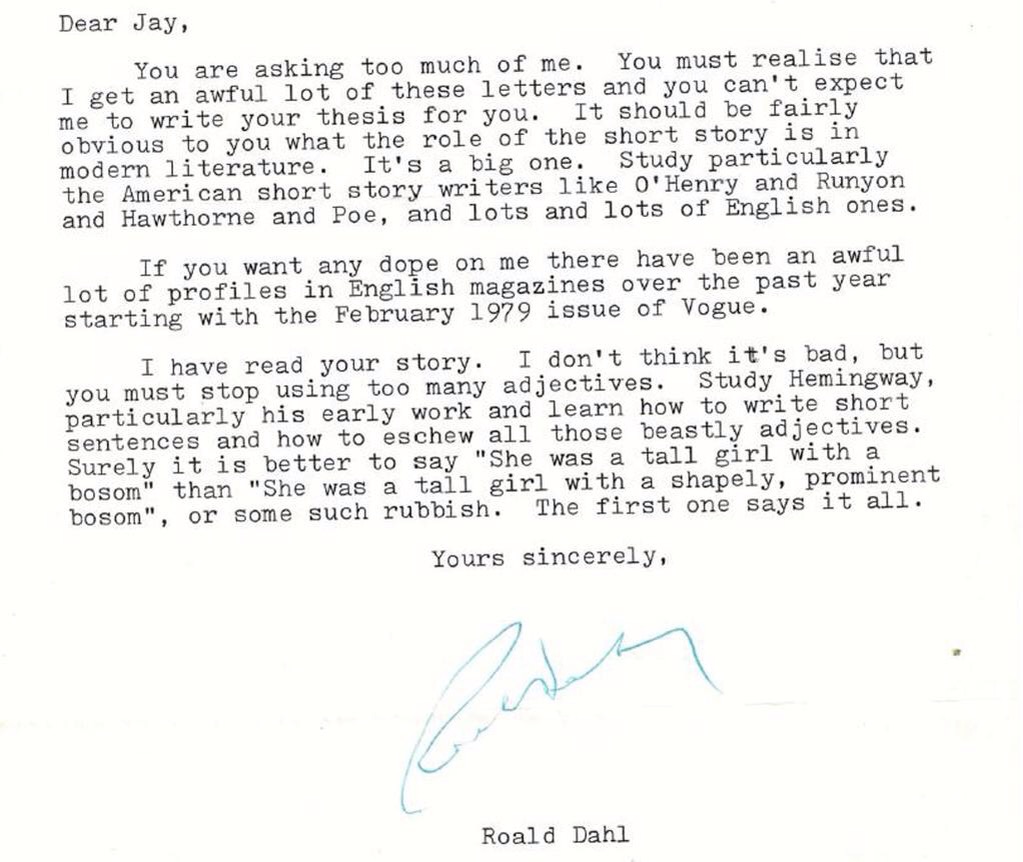
Some great advice from none other than Roald Dahl

I came across this little gem on Twitter recently. Jay Williams wrote to Roald Dahl in 1980 asking for some advice on a short story he had written. The response from Roald Dahl is blunt – but gives some great advice on how to write better stories.

IMG_4866

The Top 7 Content Marketing Trends That Will Dominate 2015

It’s that time of year when all the ‘top for 2015’ lists start coming out.

This one caught my eye – and in particular the first point that Jason DeMers makes in his post.

Publication is only the small first step – value comes from distribution.

I’m reminded of the old ‘build it and they will come’ line – it must have been nice to live in these times. Now we’ve all got to work so march harder to earn the right to be considered by our potential customers.

It’s something I see too much of in marketing – all the effort goes into producing great content with very little thought given to the distribution of this content.

I couldn’t agree with Jason more strongly on this one – it’s not the content that’s king. It’s the distribution of that content that will make you king.

If you can get the balance right between identifying the opportunity for great content, developing that content and building a network that will perceive your content as valuable then you’re well on your way to a winning content marketing strategy.

Have a read of Jason’s post for some other very interesting observations on where content marketing will take us in 2015.

The Top 7 Content Marketing Trends That Will Dominate 2015.

If you would like some help building your content marketing strategy or even just producing some more great content then get in touch:

Go back

Your message has been sent

Warning
Warning
Warning
Warning

Warning.