
I love targets. They help to define what success looks like but I think there’s a much more valuable function that they perform.
Put simply, the create clarity amongst the noise that our everyday marketing work creates.
We all have so much going on – the event you’re planning, the last minute requests for ad copy from your print and digital media campaigns, the case study you have to write, the product launch piece you need to sign off, the photo shoot for your latest project.
Having a set of clearly defined targets helps to create order from this chaos and allows you to take a look back over your activity and see what impact it is having – how it is contributing to your journey towards delivering on all your key metrics.
But it’s not simply the value of targets that I want to talk about. What I’d like to look at is how we use these targets to drive better performance. While defining the key metrics is a crucial part of this it’s only the first stage in a successful process.
It’s my experience that unless appropriate attention is given to what the evaluation and reporting process looks like the time spent setting targets is wasted time.
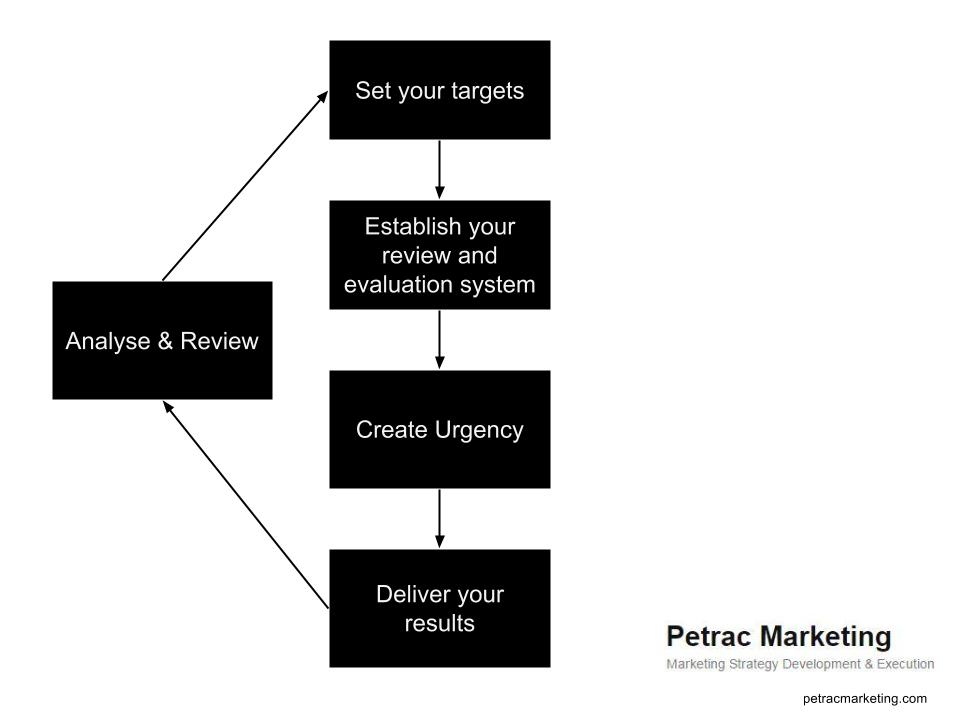
Urgency is the key ingredient in your sales and marketing strategy
Simply setting your targets is not a job in itself. It is merely an exercise that ensures you will be able to deliver value from your sales & marketing strategy.
In setting up your evaluation and review process there are a variety of issues that need to be addressed and questions that need to be asked.
How often do you review progress against your targets?
The answer to this will be inextricably linked to the sector that you are in. If you’re involved in the fast moving consumer goods sector then it’s not inconceivable that there are daily targets to be reviewed. In the B2B market this review process will usually not be as frequent.
I’ve spent a lot of time in the high value capital equipment market – focusing on the quarrying and mining equipment market. In this, and other high value capex project markets the gestation period for new sales can be very long. As a result, businesses are typically set up for quarterly reporting.
This cascades down to the sales and marketing teams charged with delivering the new sales.
We recently did a bit of analysis of new sales won by month rather than by quarter and the results were very interesting.
In each of the last 3 years the best four months sales figures were in the final month in the quarter. Even more interestingly this remained the case even when the business changed its reporting period with HMRC.
What this suggests is that the pressure to perform, the pressure to deliver the sales target created an urgency across the business. This urgency was seeming to create the environment where our sales team were able to remove all the barriers to purchase that had been in place for the previous 2 months.
So what did we do about this?
The conversations centred around how we could ensure that the sense of urgency from the last month in the quarter was present every month.
If we could do this we would smooth out the dreaded lumps in our new order ledger. This would improve cash flow across the business and ensure that investment planning decisions could be made more comfortably.
What we did was not only extremely effective – but frighteningly simple.
We moved from a quarterly reporting system to a monthly system. The sales and marketing teams had their targets redrawn to show 12 individual monthly targets. This was linked to new commission plans and bonus schemes.
The annual target was no longer one large number but twelve smaller numbers. This helped to create a new environment where a sense of urgency was present every day across every member of the sales team.
Supporting departments providing technical specifications, preparing customer proposals, finalising payment terms were all incentivised the same way to ensure that everyone was working together to deliver the common goal – the new sales at the right margin that would deliver further growth and provide the financial basis on which future growth plans were founded.
The urgency is created by the fact that the maximum amount of time left for you to deliver your next target is 30 days. This led to a considerable development in expertise within the sales and marketing team. Sales and marketing craft developed at breakneck speed because there was now a requirement to understand the customer, understand the obstacles to the deal being done, understand the competition better than they understand themselves.
What were the results?
It won’t come as a surprise that the new strategy and reporting / reward scheme took a large amount of internal selling before it was introduced.
It won’t come as a surprise that it took a while before it started delivering the intended results – but only a short while. After a slow first three months by month 4 the intended results started coming through.
Another important factor is company culture. This system creates a pressure environment. Your people need to thrive in this environment.
This system also requires that sales and marketing does not operate in a silo but that the organisation as a whole recognises the importance of new sales and works in partnership with them to help bring the new sales in.
For me it’s the perfect example of the science of selling and how an understanding of what drives people to succeed will help your business to deliver better results.
If you would like some help with any aspect of your strategy setting or review process then get in touch.


 Petrac Marketing