How to crack the ‘content’ in content marketing

For almost all the marketers I speak to the single biggest obstacle to maximising the opportunity that content marketing presents is the content bit.

It’s not that we don’t have the content ideas or that we don’t understand the principles of a good content marketing strategy. It’s quite simply finding the time to produce all of the new content that you believe prospects and existing customers will find interesting and / or useful.

Producing this valuable, helpful and informative content takes time. Before we go any further it’s important that I point out that I haven’t found a magic formula for producing new content at the speed we would all like to.

Instead, I have concluded that there is a far easier way to get the content in your content marketing strategy to work harder for you.

Sound like a plan? Let me explain:

As I’ve already said – producing good content takes time. After spending this time we unfortunately don’t maximise the benefit to be extracted from all that hard work.

I’m sure that you have on many occasions (as I have) upon completing your latest content project simply posted it on your chosen social channels, added it to your website and targeted relevant online discussion groups only to swiftly move on to the development of your next content project.

By doing this you are not maximising the potential for your content to generate leads, encourage attendance at your event, secure downloads for your white paper – whatever your specific objectives may be.

You worked really hard developing that content – so make the most of the opportunity it presents.

Only a very small proportion of your social audience will see your content if you only post it once. By using one of the many social scheduling tools and re-posting across different channels at different times you will greatly increase the exposure that your content gets.

It’s only then that you can be sure that you are extracting maximum value from the hard work you put in to developing the content in the first place.

It’s also a great way to conduct some live research – change the headlines, choose different images, post at different times of the day.

By doing this and studying your analytics you’ll develop a new awareness of what content works best, in what place and at what time.

You’ll then be in a position to decide which of your many ideas for new content will best help you to achieve your goals.

You’ll then find that all the content you develop starts working harder for you.

It’s easy to get caught in the trap of thinking that loads of content is all you need for a successful content marketing strategy.

What you really need is useful, helpful and informative content from which you extract maximum value.

I’m as guilty as anyone of being tempted by the exciting distraction of shiny new content – just remember that a lot of your existing content is new to an awful lot of people who haven’t yet been exposed to it.

What’s your most effective lead generation tool?

email marketing petrac marketing

Email marketing remains one of the most effective lead generation tools

This isn’t a rhetorical question. It’s just a question. What’s your most effective lead generation tool?

Of the many functions that we as marketers are involved with I personally believe that lead generation is the single most important activity.

This is the first stage in the sales process and allows us to help the sales team to build the pipeline that will lead to future sales.

So how do we know which is the best tool when there are so many available to us?

The cost of generating the lead is obviously a very important factor in assessing whether it represents good value. However, the cost of acquiring the lead isn’t the only factor to consider. It is also essential that we understand the potential for that lead to convert to a sale. It’s only when we understand both of these factors that we are able to make a proper judgement on whether our lead generation activity represents good value for money.

For the purposes of this post I want to focus on email marketing and explain why I believe it represents one of the best value tools on your kit bag when it comes to trying to generate new leads.

It starts with your list

Your list building activity should be focused on developing a subscriber base that you know has an interest in your products or services. By doing this you are maximising the opportunity for a high conversion rate from your email marketing campaigns.

Another key element in a subscriber list that will add value (sales) is to remember a phrase critical to email marketing success – permission marketing.

Your list is only a valuable resource if your subscribers have opted to receive information on the products and services you are offering.

List building is easy if your focus is on the wrong thing. If your focus is solely to build your list to 10,20,50 thousand subscribers then I can’t imagine your email marketing campaigns will deliver any significant value.

If on the other hand your metrics involve not only the size of your list but also monitor open rates and click through rates then you are building your list with quality subscribers – all of which combines to deliver higher conversion rates.

Understanding specific customer needs

If you’re selling a range of products or services then it’s unlikely that everyone on your list wants to receive the same content.

It’s going to offer a far better return if you send your email marketing campaigns to smaller groups with a specific interest.

All of this information is easy to obtain at the subscription stage – whether that is through a web sign up form, leads from an exhibition or registrations for an event you are hosting.

By focusing on product, service or market specific campaigns you are further increasing the potential for your lead gen activity to convert to a sale.

The delivery mechanism

Loads of great tools out there – Mailchimp, Constant Contact. Dotmailer are just three that spring to mind.

These packages have such a broad range of functionality that it’s difficult to imagine why you would try any other option. They will all manage your lists – new subscriptions and unsubscribes – produce easily digestable reports outlining your key metrics and most importantly help you to optimise your campaigns to ensure maximum open rates and click through rates are achieved.

As well as all this boring (but critical) mechanical stuff they also offer a superb range of email templates from which you can choose. If you have your own design team – that’s no problem either as you can create your own email marketing templates quickly as easily.

In summary..

Email works

This may surprise you given the volume of the stuff that we all seem to receive on a daily basis but if you get your list building strategy right then you will have a very good chance of generating leads and converting sales from your targeted email marketing campaigns.

As trade magazines (eventually) move into the digital arena they are offering expensive email blast campaigns to their large distribution lists. In my experience you can generate the same number, if not more leads at a fraction of the cost if your email marketing activities are organised in the right way.

If you would like some help developing your email marketing strategy – list building, campaign design and delivery – then get in touch:

Go back

Your message has been sent

Warning
Warning
Warning
Warning

Warning.

How to Diagnose Your Funnel to Create Predictable Growth

Why wouldn’t you click on a headline that includes the words ‘predictable growth’?

It’s what we’re aiming for every day – a way of optimising the sales funnel so that we are able to confidently predict what our sales numbers will look like in the future.

The article linked below is one of the best I have read on this subject and after reading it you’ll wonder how you didn’t already know this?

Not only does it break the sales funnel down into 3 easily understandable sections – top for traffic, middle for lead conversion and bottom for sales – but it identifies every possible scenario that will help you to identify where the inefficiencies lie within your sales funnel.

Then it only goes and tells you exactly what you should be doing to combat the inefficiencies you have identified.

If you have been baffled by trying to analyse your sales funnel and confused by the thought of how you go about working out where the problem is then I suggest that you read this article. Things will appear a lot more clear afterwards.

How to Diagnose Your Funnel to Create Predictable Growth | Marketing Automations.

Thanks to HubSpot for the original post.

Persona development for a new level of customer insight

Persona development for customer insightsThe development of customer personas isn’t a new concept but it’s definitely undergoing a bit of a renaissance at the minute. There are endless articles extolling the virtues of the activity as a way to gain really meaningful customer insights and to identify the areas where there is a knowledge gap today needs to be filled.

Despite the growing popularity of the topic and the growing acceptance of persona development as a useful – if not essential – activity I feel that the approach that most people take to the development of customer personas falls short of what is required. As a result the value that can be extracted from the process is not maximised.

In my work as a marketing practitioner with a wide variety of companies I find myself using the persona development process extensively – it’s an essential exercise in understanding the businesses I’m working with. Understanding what it is that they are selling. Understanding the dynamics of the team I’m working with (the persona development process tells you a lot about the level of insight that exists into specific customer requirements and the people with the most developed knowledge tend to end up leading the process).

Persona development is less about managing a process and more about facilitating an environment where previously unspoken customer insights can be aired. These insights can then be validated (with some additional direct customer contact) and then used to drive a whole raft of new business initiatives.

I use the term business initiatives intentionally – it is often the case that this is seen as a marketing team project but that couldn’t be further from the truth. The insights that come from an effective persona development process will have impacts right across the business and hopefully the process map below will illustrate some of these.

As I’ve already said it is essential that the process is carefully considered in order to maximise the value that you will extract from persona development. I’ve outlined a few stages below which I have found to work very well.

1 – Think carefully about the team structure

When thinking about who to include in your team there is only one thing to remember – customer empathy. This doesn’t necessarily mean those that have the most direct customer contact – although it is essential that customer facing staff are represented.

Customer empathy can be as simple as those within your organisation who work in similar roles as those people customer’s organisations.

If you’re selling to procurement departments then involve people from your own purchasing team.

If you’re selling to accountants (increasingly the case in b2b environments) then involve people from your own finance team.

If you’re selling to a particular age range or gender then involve those people in your organisation who match this profile.

Another important consideration is representation from the board and senior management. My own opinion on this is to avoid where possible – this can be quite a hard sell internally but I think it’s a conversation worth having,

The first reason for this is that you want the environment to be an open one where people feel they have the freedom to talk openly. If board members or senior management are present it can have the effect of stifling the process. No matter how flat a structure you think your organisation has it will still be the case that people can be intimidated by the presence of senior people.

It is also often the case that senior management score quote low on both the customer contact and customer empathy criteria – not because they don’t understand your customers. Other people might just understand them a bit better. There are usually other people in the organisation who have more customer contact than those at senior management level. Customer interactions with senior management may also not be as insightful as they may be with other employees as a result of being more formal – it’s through the every day conversations with your customers that the real insights can come.

2 – Create a relaxed, creative environment

People will start to make assumptions about how this process will run from the first second that they walk through the door. What we want to do is make people relax rather than start to fear what is ahead.

A really simple way of doing this is to have some music playing on the background as they enter the room. This acts as a distraction and usually results in some light hearted conversations starting – and so you’ve set the tone and the atmosphere for the task ahead.

Where possible is also suggest that you hold the sessions away from your offices. By doing this the risk of distractions and interruptions from others is eliminated.

It is also important that the session is time limited. I find a two hour session is best as after this the value being extracted drops quite rapidly. If you require another session – which you probably will – then hopefully the experience of the first session leaves the group enthused and eagerly anticipating the opportunity to do it all again.

The final one – and it’s a tough one to achieve – is to get people to surrender their phones for the duration of the session. Even if you ask for the phones to be turned off people will just put them on silent – and won’t be able to help having a sneaky look at their emails which will derail the process and kill any momentum that you’ve built up.

3 – Answer the ‘why am I here’ question

Everyone is thinking it as soon as you ask them to be involved – it’s human nature. The best approach here is to be honest – let the group know that the intention was to put together a small group of people who have been identified as having the most customer contact / empathy and can therefore being the most value to this process.

4 – Visualise the potential gains from the process

This is where you have to really illustrate the value that can be gained from creating your customer personas. At a very high level this is increased sales, better profits, better customer retention through enhanced customer service and increased opportunities to sell more to your existing customers as a result of a better understanding of their requirements.

But you need to go deeper than that. The real value in this process comes from the granular detail that you get down to – and it’s here that the process can stall as people don’t really see the point of it all.

This is where the first practical exercise comes into the session. Seeing is believing and you can do all the explaining that you like – nothing will actually beat a live demonstration.

It’s at this point that I usually try and start to map out the buying cycle. I use the format below to do this:
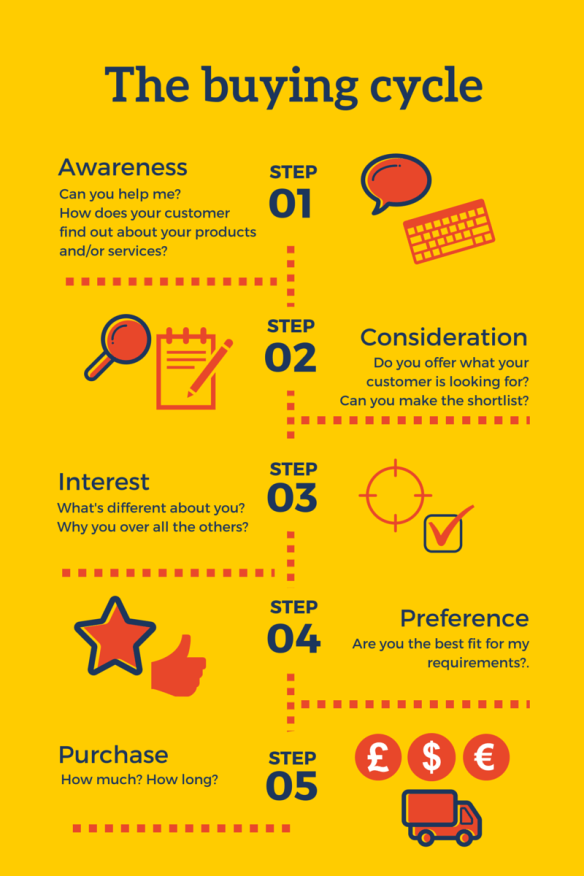
5 stages in the buying cycle petrac marketing

The purpose of creating your customer personas is to understand what you can do at every stage of the buying process to maximise the chance of your prospect choosing your product or service over all of the others that are available.

Getting to a clear definition of your the buying cycle for your product or service creates more questions than answers and this leads directly into the development of your customer personas.

5 – Drill down into the real detail 

At every stage of the process outlined above there will be questions raised that will require a detailed understanding of your prospect’s behaviour in order to be able to increase the chance of success.

It is very rarely the case that you are selling to just one type of person. There may also be different products or services targeted at different groups. You need to create individual personas for each of these because ‘one size fits all’ is very rare.

Once you’ve identified the individual you are focusing on then you can work through every stage of the buying cycle and answer the questions that will help you to gain a much more complete understanding of their requirements at every stage.

Awareness

Where are they looking for information on your products or services. Internet research? Exhibitions or trade events? Trade magazines? Referrals from other customers? Do they already know us?

You can then drill down further into this – let’s take internet research as an example. The kind of questions you can ask here are;

  1. Desktop. mobile or tablet?
  2. Are they likely to click on Google AdWords? (typically around 30% of people will click on AdWords advertising)
  3. What time of day are they doing their research?
  4. How active are they on social networks? (and which networks do they use?)
  5. What industry sources do they use and trust?

Consideration

  1. What is the specific problem they have that they are trying to find a solution for?
  2. Who else will they be considering?
  3. Are they loyal to a particular brand at the minute and how long has this relationship been in place?

Interest

  1. What are the major pain points that they are trying to overcome?
  2. What is their reason for considering this purchase in the first place?
  3. How does what you offer meet their requirements better than anyone else?

Preference

You’ve been selected as the preferred supplier – but why?

Is it price, lead time, brand reputation?

Have you demonstrated experience in solving the kind of problems that this prospect has for others?

Are you the convenient choice? Is it because you are local (or have local support by way of a retail outlet or local distribution partner)?

What criteria has your prospect used to get to this point? Is it a tendering process where scores are given under a range of different criteria? If this is the case do you understand the scoring criteria and the weighting given in each area?

Purchase

What are the barriers to getting the sale closed? Are there terms and conditions to negotiate – will your payment terms be accepted?

Is this person the only person involved in the decision to purchase or are there others with an influence?

If there is more than one person involved in the purchasing decision you need to understand their individual motivations as well – so you go back to the start and complete the process again.

Once you’ve done this across your customer base and established customer personas for the key individuals you’ll find yourself with a lot more knowledge about your customers that will undoubtedly raise a whole series of questions about how your business manages the buying cycle.

If you’d like some help developing your customer personas then get in touch:

Go back

Your message has been sent

Warning
Warning
Warning
Warning

Warning.

What’s Trending in Marketing: Top Content of the Week

With so much advice available on how you can maximise the return from your marketing investment it’s nice to find a blog post that pulls a lot of articles together. This post on LinkedIn does just that and deals with a number of interesting topics:

  • Case Studies showing how Content Marketing Drives ROI
  • How to improve the tired old content on your website
  • What content marketers can learn from traditional journalism
  • A beginners guide to keyword research for SEO
  • SEO for mobile
  • Getting the biggest SEO bank for your marketing buck
  • Advice on structuring your URL’s for the best SEO advantage
  • 17 Visualisation tools to make your data beautiful
  • What makes a truly great product great?
  • 21 thought leaders answer 17 questions

What’s Trending in Marketing: Top Content of the Week | Marketing Solutions Blog.

Forget logic. Make people love what you’re selling

make people love what you're sellingWe all like to believe that we buy stuff sensibly. We carefully consider all the options available. We weigh up the pros and cons of each available choice.

And the use of return on investment calculations isn’t the preserve of the B2B market – think of the last time you bought a car. I’m sure you considered running costs – fuel consumption, tax implications, service and maintenance charges.

So we’re all driven by logic and reasoning and as long as anyone trying to sell us something convinces us that theirs is the most cost effective choice or the choice that will last the longest or simply makes the most sense then they’re onto a winner.

Wrong.

In the centre of all of our brains is an area called the limbic system. This is where all our emotional experiences start. It’s where we experience love, happiness, joy. It’s also where we experience pain, hurt, anger.

And it is here that the vast majority of the buying decisions you make are made. The exact number is subject to some debate but it’s somewhere between 80% and 90%.

So our buying decisions aren’t based on logic at all but a simple desire to have something – that beautiful car, the stylish house, a new coat.

What then happens is we try to rationalise the desire we have for the new thing which is when we start using the neocortex – the part of the brain responsible for information processing among other things.

The car – 30mpg isn’t that bad and I don’t really do too many miles anyway so it won’t hurt that much.

The new coat – I haven’t got a blue one and it’ll go with loads of my other clothes so I’ll definitely get my money’s worth.

The new 60 inch TV – I’m only getting it so I can enjoy watching the sports in the house. Think of the money I’ll save by not going to the pub to watch the game.

If we made every buying decision using only logic and reasoning we would only buy things that we need.

Every car on the road would be the most fuel efficient one available.

Every coat would be designed for a specific purpose – rain protection, winter sports – with no consideration for aesthetics.

And in the age of online reviews the only products to sell would be those with faultless 5 star reviews.

Thankfully this is not the case.

What it means for anyone selling anything is that it is essential to understand what it is about your product that will trigger the necessary emotional reaction from your customers.

Of course this is much easier for retail, fashion and mass market consumer brands than it is for those in the B2B market but with a bit of careful thought you can find your product’s emotional trigger.

It may be the design of your product that seals the deal. Go the extra mile with the design of your product – think about form as well as function and you’ll increase your chance of success.

Don’t worry if you’re selling services – you can play this game too. We’re social animals – so use the currency that your personality represents. Be transparent and authentic and you’ll establish meaningful relationships with your customers that are very hard to break.

Stand for something – display your passion for what it is you do. People don’t buy what you do – they buy why you do it. By showing that you really care about delivering the best solution to their problem what you’re saying is ‘I won’t let you down’.

So let’s put the return on investment sheet to one side for the minute and get to work on nailing down the ways that you can make your customers feel more connected emotionally to your products or services.

This requires that you have an in-depth understanding of who your customers are and what their specific needs are. This has to go beyond their job title and their role in the procurement process as this alone just will not give you the insights you need.

You need to understand their daily frustrations – the pain points in their everyday existence that your product can help to overcome. Once you’ve done this you can craft your marketing messages to push these buttons.

If you’d like to read more about the part emotions plat in your decision making then I’ve included a few links below to some articles that I found interesting:

Decisions are emotional, not logical – the neuroscience behind decision making.

Delving into the logical and emotional sides of the human brain.

If you would like some help understanding the emotional triggers that will allow you to sell more effectively then get in touch:

Go back

Your message has been sent

Warning
Warning
Warning
Warning

Warning.

7 Reasons Why Bad Website Design Decisions Get Made

I cam across this great post on why bad website design decisions get made (published on the Tribute Media website).

Of the 7 points that are made there is a common theme that runs through them all.

In far too many cases the decisions that are made about the best design are too focused on what the organisation would like to achieve rather than what the visitors to your website are there for in the first place.

This is a result of the focus being in the wrong place – too much time is spent on coming up with a website design that gets the approval of the powers that be. The damaging effect of this is to further disconnect your website from the people who will be using it.

At the very outset of your website design journey you should be spending a lot of time researching who it is that visits your website and what they want to do when they get there.

7 Reasons Why Bad Website Design Decisions Get Made.

why bad website design decisions are made

7 reasons why bad website design decisions get made – original post from Tribute Media

All of this information is very easy to get:

Have a look at your current website analytics – there is a wealth of information in here about current user behaviour. Where are your users coming from? What content is most popular? Where are your poorly performing pages?

in addition to this you should be profiling your different website users – creating personas for the people who visit your website is a very useful exercise that will allow you to better understand how to deliver a positive website experience for your visitors.

This can be easily achieved by talking to the customer facing people within your organisation. Your sales team is the obvious first step but don’t ignore the others in your organisation that can add some serious value to this process.

If you discover that you are selling to procurement departments, then involve your own in this profiling exercise as you’ll often find that what is important to them gives you an insight into what motivates your customers’ buying decisions.

The same is true if you find that you are selling to accountants – increasingly it is accountants who occupy the Managing Director or CEO position. Involving your own Finance Director or CFO will allow you to expand your awareness of what questions these people are likely to want answered when considering buying a product like yours.

It is this focus on your visitors that will allow you to create a website that will ultimately deliver you increased conversions – whatever that conversion may be. It could be increased sales, increased white paper or brochure downloads, increased enquiry levels, increased registrations for the event you are running, increased donations for your charitable cause.

Whatever sector you are operating in – public, private or third sector – the process should be the same.

In my experience a lot of the conflict and pain of a new website design project is as a result of a misplaced focus on the subjective elements of the website design.

It is virtually impossible to get a cross section of people to agree on a design that they all like – we all prefer different websites for different reasons. When your project uses consensus on the design of your new site as the starting point or your project it is destined to take longer than you originally planned for, cost more than you originally planned for and – most importantly – deliver a website that it not configured to achieve its objectives for improving business results.

Your website is not a vanity project – it’s a project that when delivered correctly will deliver real, tangible, positive results for your company or organisation. But only if you get back to the science of the process and remove subjective decision making.

7 Reasons Why Bad Website Design Decisions Get Made.

If you would like some help with your website project then get in touch:

Go back

Your message has been sent

Warning
Warning
Warning
Warning

Warning.

Create your own images for free

There are numerous online image creation tools available but the one I’m using most the minute is Canva.

There are so many templates available for you to use so whether you’re looking for a simple facebook or twitter header profile, business cards, posters or infographics they have made it so easy to use.

canva design templates

Just some of the free image templates available on Canva

The process is really simple – you select from a range of design templates and then customise it with your own text and images. As a starter the free templates offer more than enough scope for you to explore the capability of the system.

There is of course a library of premium themes which you can access – I haven’t found any need to use these yet but they do offer expanded libraries of design templates and more flexibility when it comes to layouts.

As well as all the social media images you can create I also use the tool to help create images for sales presentations to existing and potential clients. The image sizes are designed to fit with Powerpoint / Keynote and are really quick and easy to create.

Presentation powerpoint image Canva

Presentation image created using Canva

For beginners on the system there is a Canva Design School  which contains a library of tutorials on how to use the system.

Canva design school create images for free

The Canva design school tutorials

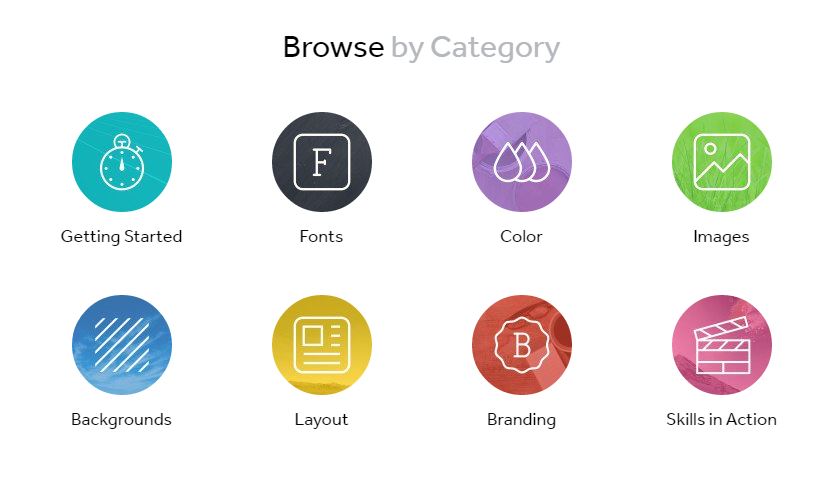
You can also browse the design school by category to find help with the specific project that you’re working on.

Canva Design school categories

Browse by category on the Canva Design School

Once you’ve created your free images you can either keep them private or share them to show others the designs you have created. Even if you want to keep your own images private you can search the Canva Stream to see the most recently published images. This is a great resource for finding out how you could use the system for yourself.

Canva design stream create your own free images

Canva design stream shows the most recently created images

If you’d like any help discovering how you can use Canva to benefit your business then get in touch:

Go back

Your message has been sent

Warning
Warning
Warning
Warning

Warning.


6 web development misconceptions of CEO’s

website design pic

Your website project needs careful consideration

An recent article on the Entrepreneur website outlined 6 common misconceptions that CEO’s have about web development.

The article was written by Zach Ferres and while I agree with some of the points he makes there are some others that I think merit a little more discussion.

I think the article starts off on the right note:

Remember the last website project you were involved with – the one that went over budget and missed all the project deadlines that were agreed at the outset – was most likely your fault (by using the term ‘your’ I’m assuming that you were part of the marketing department that was in charge of leading the project within your organisation).

There is no doubt that most website projects are a lot more painful than they need to be. It really is very simple – and with some forward planning and a better understanding of what it is that you are trying to deliver you can avoid all of this pain.

One of the best lines I’ve ever read about web development projects came from a guy at a company called Fathom in Belfast – he said ‘It’s entirely possible for a website to be pretty and pretty awful at the same time.’

Why does this happen? Because too many web development projects are built around what we (the organisation) want to talk about rather than what our customers are actually looking for. I’ve written another post on this very subject called ‘Your website – for you or your customers?’

Anyway, back to the 6 misconceptions that CEO’s have about web development:

1 – Website development is easy

I agree with Zach Ferres here – those not directly involved in the project have very little appreciation for how long the ‘under the bonnet’ development work actually takes. Our role as project leaders for the web development project is to try and build this understanding – break down the project plan into the relevant phases that your development company has given you and highlight the time devoted to the development work.

This is difficult because most CEO’s, other board members and other people in your organisation are just dying to see the big reveal of your new home page design. They care very little about the journey planning element of the website architecture which is essential if the website is going to perform to maximum potential.

My advice – involve them in this stage. Get them involved in understanding who it is that is visiting the site and what they are trying to achieve when they get there. This will help to build an evidence based argument about what content should be on the site and where it should live.

2 – Everyone should be involved

In the original post Zach Ferres believes that the project should only be left to the people doing the work – I’m afraid I disagree. I’ve seen too many website projects fail because the project didn’t have the buy in of people across the organisation.

I believe it’s wrong to assume that only marketing will know what people are looking for when they visit your website – this is not a marketing project.

Your website is a project that should involve as broad a cross-section of people and opinions as you can muster. All of this work should be done at the outset and once all of the intelligence has been gathered then the build process will come together a lot more quickly than without these essential steps.

You will also find the because buy-in now exists across the organisation the final website will be much better received internally when your launch date arrives. This is because the decisions about how to categorise information, how to present information, what calls to action to include were all taken by your development group and were based on evidence.

This avoids subjective opinions on colours, button sizes and the location of information being used as the basis on which people judge your website. The only judging criteria worth considering is the user experience on your website and ultimately the results that it delivers for your business.

3 – Websites are a commodity

I am fully behind Zach on this one – if you want to use free website build templates for your website project you’ve got to accept their limitations. The more customisation you want to be able to introduce to your website, the more likely it is that a custom build is the route you are going to have to take.

4 – Once a site is built it’s done

Your website project doesn’t have a completion date – the end of the development project is marked by your ‘go live’ date. This is only the beginning of the journey to turn your website into a pipeline stuffing machine (or whatever your stated objective is from the website).

5 – Anyone can create a great user experience

While Zach Ferres disagrees with this statement in the original post I’m actually inclined to support the view that anyone can create a great user experience on their website.

The problem is that most people don’t.

But the reason why they don’t is (in my humble opinion) a result of the process that is followed during the web development project.

Too many projects jump straight into defining the various menu options and then deciding what information to house in these silos. Then the marketing department starts writing copy (largely with the aim of hitting all the required keywords).

And all of this is done with no consideration for who will be visiting the site.

Before a line of code is written, a menu option decided on or a word of copy written you need to go right back to the start.

  • Who is it that visits your website?
  • What are they looking for when they get there?
  • How did they get there in the first place?
  • What other sites have they been on before they got to yours?
  • Is this the first time they’ve been to your site or are they a repeat visitor?

Doing an internal workshop with the people in your organisation who interact with customers most regularly will give you some great insights into what content you actually need to look at for your new website.

You can then validate this information by asking some of your customers whether your assumptions are right. This is extremely powerful – it takes the guesswork out of the exercise and gives you confidence, even during the build process that you are building something that will deliver better results for your business.

This is a very simple process – anyone who knows about your business can contribute whether they’ve built a website before or not.

6 – It’s your website so you dictate the design

I’m back to agreeing with Zach again on this one – there are web designers with much better knowledge of what works in relation to web design than you. They will make sure your site follows best practice guidelines which will maximise the potential for your website to deliver for your business.

Once again, ask yourself the question – is your website for you or your customers?

No project should be signed off until it has been tested with real users and feedback taken and acted upon to improve the site experience.

Thanks to Zach Ferres for the original post. I hope you find these observations useful.

If you’re working on a website development project and you’d like some help then get in touch.

Go back

Your message has been sent

Warning
Warning
Warning
Warning

Warning.


Consistency is far better than rare moments of greatness

Chess board represents marketing strategy

Random moves lead to defeat – strategy is what is required to win

I love this line – the title of a book by Scott Ginsberg from 2012.

For me it sums up what marketing is all about. While others may judge us on the impact of an individual event, video etc we should be judged on consistently delivering results that will allow our businesses to achieve their goals.

It is far too often the case that marketing is judged on the tactics employed rather than the overall results – and this is because of a disconnect between the overall business strategy and the marketing activities that we are engaged in.

Rare moments of greatness happen by accident rather than design. They happen because we’re just trying to do a lot of different stuff with the digital channels available to us without proper consideration for what we’re trying to achieve or what success looks like. It’s inevitable that the more we do of this stuff, the more we learn about what works and the better we get at spotting content that is likely to get a good reaction online.

And this is part of the problem – an endless pursuit of Facebook likes does not constitute a strategy. It is merely a tactic to help you deliver something valuable. So what is it that you’re trying to deliver? The problem is that a lot of people just don’t know.

To move from rare moments of greatness to the consistency that will deliver real business value you need to take a step back – ignore all the tools you have available to you and focus on what it is you are trying to achieve.

The first step is to understand what your goals are – this is derived from your overall business strategy. This could be to win a certain amount of new sales / donations within a new sector or market or increase market share to give some examples.

From this we are then able to define what the goals of our marketing efforts are:

Are we trying to drive traffic to our website or blog because we know this generates more leads?

Are we trying to provide resources and information to assist our customers with their buying decision?

Are we trying to build a social following to build our reputation in the industry?

Once you know what it is that you’re trying to achieve you then need to know how you’re going to measure success.

If we’re trying to drive traffic to the website to generate more leads – how much traffic do we need and how many leads should this convert to?

If we’re trying to provide resources and information to assist customers with their buying decision – how many downloads of the whitepapers, brochures and case studies are we looking for?

If we’re trying to build a social following – how many new likes or followers are we trying to win? Or maybe focus on the engagement metrics instead – the conversations that begin because we started them, the number of times our content was shared?

When you have these things in place you can then start thinking about the tactics that you’re going to employ to help you achieve your goals. It’s only now that the channels come into the equation – where do your target audience hang out, what is the best way to connect with them when they are there and what content will they find either useful or interesting? This should include both online and offline channels to deliver the best results.

A well considered digital strategy will yield results for your business – simply because you now know what you are trying to achieve.

This will allow you to quickly and easily report on progress internally and demonstrate to the cynics in your organisation the value you are adding through your digital content marketing activity. This focus on performance is what is all too often missing from the marketing function.

Too many KPI documents for the marketing department are littered full of tactics that shift and change depending on the latest requests from the board or the sales team. All this does is measure activity – and just because you’re busy doesn’t mean you’re adding any value.

By stepping back and considering what it is that we are trying to deliver we can shift the focus from the activity to the value that we are adding and this is when we will achieve consistency.

Because consistency is far better than rare moments of greatness.

If you would like some help either developing your digital marketing strategy or deploying the tactics to ensure success then get in touch.

Go back

Your message has been sent

Warning
Warning
Warning
Warning

Warning.