I was recently invited by the team at Digital DNA to contribute a guest blog in advance of the upcoming conference in Belfast on 8th June 2016.
The focus for my article was the opportunity for us as marketers to seize the new opportunity that exists for us to not only be content producers but also to be the distribution channel in this new digital world.
I recognised the value of STEM when the term was first introduced into our vocabulary to represent the increasing focus on Science, Technology, Engineering and Mathematics.
It was a useful tool for discussions around education, employability and making sure that our education providers knew that industry needs these skills in order to maximise the potential for growth and innovation.
However, I now think that the time has come where the expression ‘too much of anything is bad for you’ is true of STEM. It seems to me that the story has progressed from simply recognising that STEM subjects are an important part of the mix when it comes to the skills society needs to prosper.
It has now reached the stage where STEM appears to be all that is spoken about in any conversation about education and this approach is disrespectful to the contribution that many other subjects make to the society we live in, the schools we learn in and the businesses we work in.
Art and design have a huge role to play in the future success of our businesses as well as helping to create a rounded society which is self-aware and uses this knowledge to create better products, better services and better relationships with our customers.
In today’s world, where everything has to be measured on a spreadsheet, art, design and the humanities are at risk of being phased out because there is no obvious formula to measure the positive impact they have on us as individuals or on our businesses and customers.
But STEM subjects alone will not provide us with the insights we need in order to be able to understand how our customers will interact with us. More than 80% of all the decisions we make are emotional ones rather than rational ones. The only predictable thing about our interactions with human beings as customers is that they will be completely unpredictable. It’s those with an understanding of and an education in the art, design and humanities subjects that will bring this understanding to the game.
The growth in popularity of The School of Life in recent years provides some evidence of a growing realisation of the value that art, design and humanities can offer the business world.
What started as a self-help project to help people build more meaningful relationships and become more fulfilled in their own everyday lives has developed into a tool that hundreds if not thousands of businesses are using to develop deep emotional connections with customers.
It’s time to evolve STEM. A recent incarnation of this is STEAM with the ‘A’ representing the need to also focus on art, design and the humanities. There is a huge amount that art, music, design and philosophy can teach us about ourselves and it is this knowledge which will help us to better understand our customers, leading to better new products, stronger customer relationships and more profitable businesses.
So let’s grasp the opportunity that this presents and realise that balance is the answer. This is how we will deliver what our businesses need in the future.
Honesty is the best policy. It’s one you’ve probably heard before. Here’s another one – the old ones are the best.
While this isn’t a new concept if you’ve been watching any of the coverage of the British General Election recently you would think the concept of truth is an alien concept for those standing for election. I’m also fairly sure that this isn’t an exclusively British phenomenon.
I have come across those who believe that the purpose of marketing is to con people into buying your product. It seems that the major political parties in the UK (and even the not so major ones) also subscribe to this view.
Staged election canvassing events where small crowds of party activists are crammed together with the photographer told to get in nice and tight so that it looks like a huge crowd.
Completely unsubstantiated claims about cuts to this, extra funding for that.
The complete exploitation of any statistics that exist and the twisting of the facts to suit their own agenda.
And even when the supposed ‘experts’ reveal that their plans aren’t affordable, achievable or even believable they adopt a policy of continuing to peddle their untruths in the hope that we all fall in line.
Truth has always been the core ingredient of successful marketing. Truth around the capability and performance of our products and services. Honesty and integrity in how we treat our customers.
The same is true in how politicians market their policies. They seem to forget that we are operating in a time when voters / consumers have never been as well educated about our policies / products.
When working to create any marketing collateral the question I ask the most is ‘where is the evidence?’
Where is the evidence that your product will cost less to run than the current one?
Where is the evidence that your product is easier to use?
Where is the evidence that you’re better than the competition?
Successful marketing isn’t about bold statements with no substance.
Successful marketing isn’t about making claims that simply don’t stand up to challenge.
Successful marketing is about building products / policies based on an understanding of what will make your customer’s life quicker, easier, more efficient.
If you are not able to make honest claims about what your product / policy can do for your customers / voters then maybe you don’t properly understand your product? Maybe you don’t properly understand your customers?
Or maybe your product doesn’t meet your customers’ requirements and needs a redesign.
Marketing isn’t alchemy. Marketing isn’t a con game – it’s simply a mechanism for showcasing your product or service in all its glory.
So stay honest and make truth your guiding principle.
Over the decades marketing has changed. The tools we use have changed. The delivery mechanism for our messages has changed. Our audience has changed. Fonts, colours, design trends change so often that it can be hard to keep up.
In this environment where there is so much change how do we go about building marketing teams that are future proof?
How do we go about ensuring that we back the right horses when recruiting to ensure that we can continue to deliver the results from our marketing activity that will continue to drive our business forward?
It may please you to know that the solution to this problem may not be as complicated as you think.
Why? Forget about change since the Mad Men era. The truth is that over the centuries marketing hasn’t changed. For hundreds, if not thousands of years people have bought products that they feel a connection with. What remains true today is that the main function of your marketing efforts is to make people believe in what you are selling.
In order to make other people believe in what you are selling you have to believe in it yourself. This is supported by the fact that in my experience working with small and medium sized businesses the company founder often remains the best performing sales person. This is because they are driven by the passion and belief that saw them start the company in the first place.
We’ve all experienced it. We’ve all heard people talking about their product or service with such passion and belief that we’ve immediately bought into the idea. We want what they’re selling.
So when you’re adding a new person to your marketing team make sure that you take the time to find out whether they can bring this passion to their efforts. All the qualifications, experience and training in the world will not trump passion – the most important skill a marketeer can have.
But how do you go about assessing this during a recruitment process?
This is a question I’ve struggled with myself. During our recruitment efforts we tend to put the focus on ourselves.
What do they know about our company? – a pointless question which just involves a recital of all the information on the ‘About Us’ page of your website.
How would they go about selling product X in country Y? A tick box exercise in whether they’ve done this sort of stuff before.
The answer is to stop focusing on you and start focusing on them.
They don’t have a passion for your products or services. They can’t. They don’t know enough about them.
They will be passionate about something though.
Maybe it’s the sports club that they are a member of.
Maybe it’s the charity work that they do.
Maybe it’s the hobby that consumes their every free moment. Their garden, their record collection, their love of old lawnmowers.
So instead of asking them to deliver a presentation on how they would improve YOUR website, improve YOUR branding, identify YOUR unique selling points just change the focus.
Ask them to tell you about something that they are passionate about. What it is. Why it is important to them. How it makes them feel.
This will give you a real insight into how passionate they are likely to get about your product.
All the tools that we need to master as marketeers will change. The need for us to have a real passion for what we’re selling is a constant. So focus your efforts here and you’ll not only enjoy much more fulfilling and informative interviews but you’ll build a formidable marketing team.
It’s all about passion – because that’s what all great marketers have in common.
And truth – but that’s for another time.
If you’d like some help building your marketing team then get in touch.
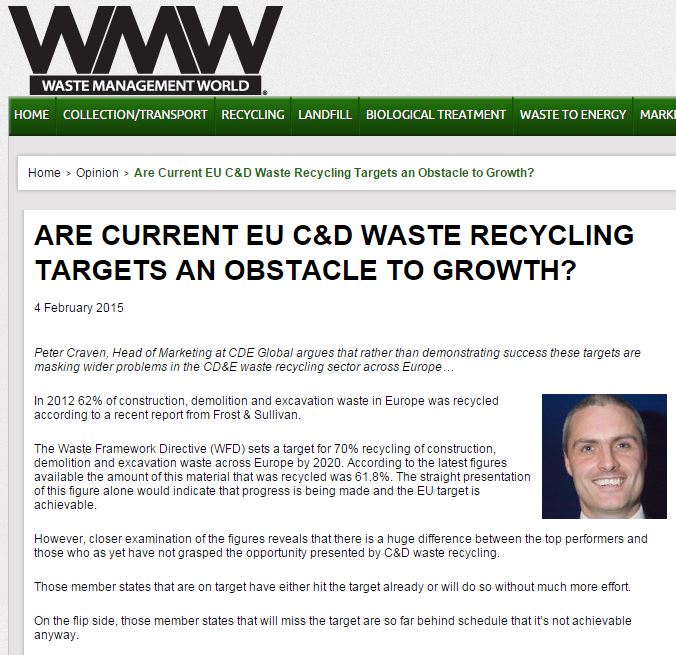
I recently wrote an article about the current EU targets that exist for the recycling of construction, demolition and excavation waste and whether they are structured in a way which encourages innovation and improves performance.
The article has featured in a number of publications and one of these is the Waste Management World publication – you can read the article on the Waste Management World website below.
It seems that everyone is searching for the silver bullet that will allow them to create viral campaigns at will. I think this is a problem.
The endless focus on viral and how it can be achieved suggests to me that there is a misconception that a viral campaign is the single key performance indicator that matters. The suggestion here is that viral automatically equals success. While there is no doubt that this is the case in some instances I think there are more than enough examples of viral campaigns that simply haven’t worked – they haven’t delivered any significant business result.
I’ll illustrate this by looking at examples of 2 viral campaigns – both of which would have been described as successful if the only measure was whether they achieved the ‘viral’ badge of honour.
One of the best examples of a successful viral campaign is the ongoing campaign run by Blendtec to promote the blenders that they produce. This is one of the most often quoted examples of successful viral campaigns and it’s easy to see why. They didn’t just create one video that went viral – they’ve managed to sustain their success over a reasonably long period of time (digital years, as we all know are like dog years in fast forward).
Their video showing the blending of an iPad using a Blendtec blender has to date had almost 17 ½ million views on their Youtube channel. The iPhone in the blender has had 12 ¼ million views. Other products that have had the Blendtec treatment include golf balls, crowbars, magnets and marbles.
The Blendtec story has so many factors that made it successful – the first video that went viral was simply the delivery mechanism for the campaign.
First of all, they have a great product – the rationale for putting all this weird and wonderful stuff through a blender was to demonstrate the strength of the blender. If it can blend an iPad or a golf ball it’s going to have no problem making your breakfast smoothie. So the campaign had a clear purpose – demonstrate one of the key unique selling points of the product.
Secondly, it’s a mass market product. Achieving almost 30 million views for the iPad and iPhone videos is a step in the right direction for Blendtec in making their product more well known and more desirable. The potential for people to decide to buy a Blendtec blender is almost beyond comprehension – it’s not inconceivable that every home in the world could have a Blendtec blender.
The key thing that determines whether the Blendtec campaign was a success is the difference it made to their sales numbers. The results here are astounding – in 2009 it was reported that after the first 186 videos sales were up 700%.
All of this was possible because the campaign had a clear purpose and a solid business behind it.
This is a viral campaign that worked – not because it went viral but because it delivered a significant business result.
Equally, there are mass market brands that try and run viral campaigns that aren’t as successful. One of the best to illustrate the point that viral alone doesn’t mean success was done by Kodak back in 2007.
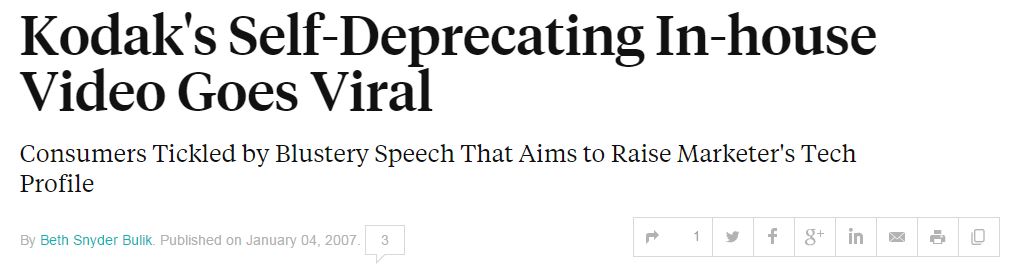
Headline from a Adage article on the famous Kodak viral campaign
This video sought to address the perception that Kodak was a tired old brand that had been left behind by the digital photography boom. They had failed to spot the changing demands of their customers and they tackled this issue head on with the launch of a video which was very self deprecating – admitting all the mistakes of the past and recent present but promising that it was all about to change.
Personally, this was one of the best videos that I ever watched online – but despite numerous searches it’s just not available any more. Why? Because in 2009 the company went out of business.
While the campaign achieved the objective of going viral it didn’t make one blind bit of difference to the prospects for the company. Why? Because viral isn’t a healthy objective to have for any campaign.
The Kodak campaign was destined to fail because it had no purpose other than going viral, no substance to back up the claims they made in their video. They may have talked about embracing the digital revolution and to watch out for all the new technology that they were about to unleash on the market. But the fact was that they didn’t have any of this. It was an elaborate cover story to try and buy some time.
I bet when the Kodak video went viral the agency involved and the Kodak marketing team were busy patting themselves on the back about what a wonderful job they had just done. For them, the viral video was evidence of success. The proof that this has no foundation is what happened to Kodak in 2009 when they closed their doors.
I think these two campaigns represent the 2 extremes of viral campaigns.
Blendtec is a great sales, marketing and product development story that demonstrates the value in understanding your customers, understanding your product and having a clear objective for your campaigns.
Kodak is an example of viral for the sake of viral. That’s as much substance as there was. Was it clever? Yes. Was it funny? Yes. Did it reach a massive audience? Yes. Did it work? No.
What this says for me in that in the midst of this technological age success in sales, marketing and business in general is still down to a few good old fashioned things:
A great product, in the right market, at the right price, delivered through the best sales channel with superior customer support and a great sales team.
Get these basics right and your success will be long term and tangible rather than a flash in the pan viral campaign.
I’m sure I’m not the only one who has been listening to people talking about how good it is to see the price of petrol, diesel and home heating oil coming down over the last few weeks.
There seems to have been something missing from the coverage of this though. It was only a few months ago that hysteria was being created over the plans to drill a bore hole in Fermanagh to see whether there was shale gas that we could exploit – or more accurately that a Canadian company called Tamboran Resources could exploit.
While the media were very happy to report all the alleged environmental dangers that fracking poses at the time when the fracking protests were going on in Fermanagh there has been a distinct lack of balance recently.
At no time during any coverage of the falling oil price have I heard any mention of the fact that the fracking boom in the US is a contributory factor. It is thanks to the exploitation of the shale gas reserves in the US that the oil price has fallen to its lowest level in a number of years.
Is it impossible to have a sensible, grown up conversation about fracking and the potential it offers for us all to save money on the fuel we consume every day?
Or will the arguments continue at the extremes – earthquakes being caused at one end of the scale and zero environmental damage at the other.
It seems to me we have a choice to make – and there is going to have to be a trade off somewhere.
But if we’re expecting our politicians to take the lead on this and try and engage in a sensible conversation then I can’t see much happening. Once again the local parties will respond to calls from an uneducated public (and I include myself in that) rather than seeking to explore the pros and cons of the argument in relation to fracking.
I don’t know how much damage fracking will cause – if any. What I do know if that I quite like the sound of lower fuel prices – and I don’t think I’m on my own.
Over the last decade Belfast and Northern Ireland have been transformed.
The Titanic building was a stroke of genius and is something that everyone in Northern Ireland should be proud of. People travel from all over the world to see what is on offer at Titanic.
Belfast as a City has come on leaps and bounds in the last decade – restaurants, bars, pubs, clubs, concert venues, theatres. Something for everyone. The next time you’re walking around the City Centre pay attention to just how many tourists are now visiting our country.
We had the Giro D’Italia last year, the Irish Open returns to Northern Ireland next year, Radio 1 hosted their big weekend in Derry / Londonderry.
Everything is going in the right direction…
And then we hear of the cuts to the budget for the Department of Culture, Arts & Leisure – the upshot of which will be our museums will host fewer exhibitions and events, funding will be withdrawn for the very events that attract the visitors in the first place. There can be no doubt that this will also lead to people losing their jobs.
Most frustrating of all is the often peddled argument – the return on investment on the arts doesn’t add up. I hope those peddling this falsehood remember their words when the Northern Ireland Tourist Board inevitably reports on a drop in visitor numbers as a result of these cuts. People won’t come here if there is nothing to come here for.
The events that receive funding from the Department of Culture, Arts & Leisure are an investment in our infrastructure that helps to support the positioning of Northern Ireland as an attractive destination for tourists.
Simply seeing it as a cost is a blinkered view that needs to stop if we are to continue to build on recent successes.
Never mind the latest instalment of pointless ramblings at Stormont where our neanderthal politicians will spend the next month in their tribal gear knocking ten shades out of each other and getting nowhere.
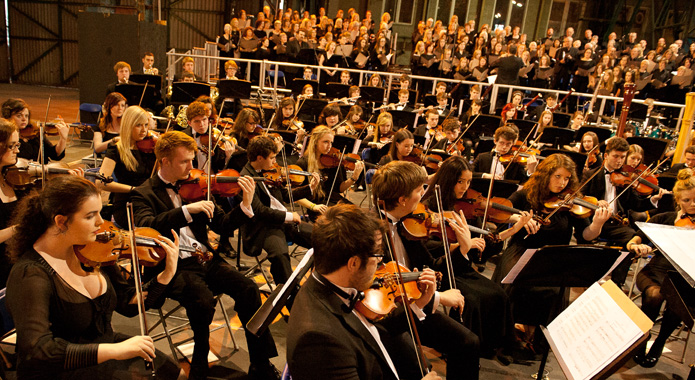
Stand up for the Ulster Orchestra
Meanwhile, in the real world the same politicians – that approximately half of us vote for – are systematically turning the places we live into joyless places where any experience that might actually enrich our lives is cast aside because the return on investment doesn’t add up.
What price the joy of a child learning to play a new musical instrument?
What price the joy of discovering that music is mind and mood altering? It can bring joy from the depths of despair, it creates memories that will never be forgotten.
What price the release that music gives you after another day on the treadmill?
You may not listen to classical music but this still affects you – they’re coming for whatever you get your joy from and they’re dismantling it.
It can’t be allowed to happen. It’s not even the Ulster Orchestra we’re standing up for. We’re standing up for our desire to live somewhere that is actually a nice place to be, where people want to come and visit, where enjoyment is around every corner.




 Petrac Marketing