 The development of customer personas isn’t a new concept but it’s definitely undergoing a bit of a renaissance at the minute. There are endless articles extolling the virtues of the activity as a way to gain really meaningful customer insights and to identify the areas where there is a knowledge gap today needs to be filled.
Despite the growing popularity of the topic and the growing acceptance of persona development as a useful – if not essential – activity I feel that the approach that most people take to the development of customer personas falls short of what is required. As a result the value that can be extracted from the process is not maximised.
In my work as a marketing practitioner with a wide variety of companies I find myself using the persona development process extensively – it’s an essential exercise in understanding the businesses I’m working with. Understanding what it is that they are selling. Understanding the dynamics of the team I’m working with (the persona development process tells you a lot about the level of insight that exists into specific customer requirements and the people with the most developed knowledge tend to end up leading the process).
Persona development is less about managing a process and more about facilitating an environment where previously unspoken customer insights can be aired. These insights can then be validated (with some additional direct customer contact) and then used to drive a whole raft of new business initiatives.
I use the term business initiatives intentionally – it is often the case that this is seen as a marketing team project but that couldn’t be further from the truth. The insights that come from an effective persona development process will have impacts right across the business and hopefully the process map below will illustrate some of these.
As I’ve already said it is essential that the process is carefully considered in order to maximise the value that you will extract from persona development. I’ve outlined a few stages below which I have found to work very well.
1 – Think carefully about the team structure
When thinking about who to include in your team there is only one thing to remember – customer empathy. This doesn’t necessarily mean those that have the most direct customer contact – although it is essential that customer facing staff are represented.
Customer empathy can be as simple as those within your organisation who work in similar roles as those people customer’s organisations.
If you’re selling to procurement departments then involve people from your own purchasing team.
If you’re selling to accountants (increasingly the case in b2b environments) then involve people from your own finance team.
If you’re selling to a particular age range or gender then involve those people in your organisation who match this profile.
Another important consideration is representation from the board and senior management. My own opinion on this is to avoid where possible – this can be quite a hard sell internally but I think it’s a conversation worth having,
The first reason for this is that you want the environment to be an open one where people feel they have the freedom to talk openly. If board members or senior management are present it can have the effect of stifling the process. No matter how flat a structure you think your organisation has it will still be the case that people can be intimidated by the presence of senior people.
It is also often the case that senior management score quote low on both the customer contact and customer empathy criteria – not because they don’t understand your customers. Other people might just understand them a bit better. There are usually other people in the organisation who have more customer contact than those at senior management level. Customer interactions with senior management may also not be as insightful as they may be with other employees as a result of being more formal – it’s through the every day conversations with your customers that the real insights can come.
2 – Create a relaxed, creative environment
People will start to make assumptions about how this process will run from the first second that they walk through the door. What we want to do is make people relax rather than start to fear what is ahead.
A really simple way of doing this is to have some music playing on the background as they enter the room. This acts as a distraction and usually results in some light hearted conversations starting – and so you’ve set the tone and the atmosphere for the task ahead.
Where possible is also suggest that you hold the sessions away from your offices. By doing this the risk of distractions and interruptions from others is eliminated.
It is also important that the session is time limited. I find a two hour session is best as after this the value being extracted drops quite rapidly. If you require another session – which you probably will – then hopefully the experience of the first session leaves the group enthused and eagerly anticipating the opportunity to do it all again.
The final one – and it’s a tough one to achieve – is to get people to surrender their phones for the duration of the session. Even if you ask for the phones to be turned off people will just put them on silent – and won’t be able to help having a sneaky look at their emails which will derail the process and kill any momentum that you’ve built up.
3 – Answer the ‘why am I here’ question
Everyone is thinking it as soon as you ask them to be involved – it’s human nature. The best approach here is to be honest – let the group know that the intention was to put together a small group of people who have been identified as having the most customer contact / empathy and can therefore being the most value to this process.
4 – Visualise the potential gains from the process
This is where you have to really illustrate the value that can be gained from creating your customer personas. At a very high level this is increased sales, better profits, better customer retention through enhanced customer service and increased opportunities to sell more to your existing customers as a result of a better understanding of their requirements.
But you need to go deeper than that. The real value in this process comes from the granular detail that you get down to – and it’s here that the process can stall as people don’t really see the point of it all.
This is where the first practical exercise comes into the session. Seeing is believing and you can do all the explaining that you like – nothing will actually beat a live demonstration.
It’s at this point that I usually try and start to map out the buying cycle. I use the format below to do this:
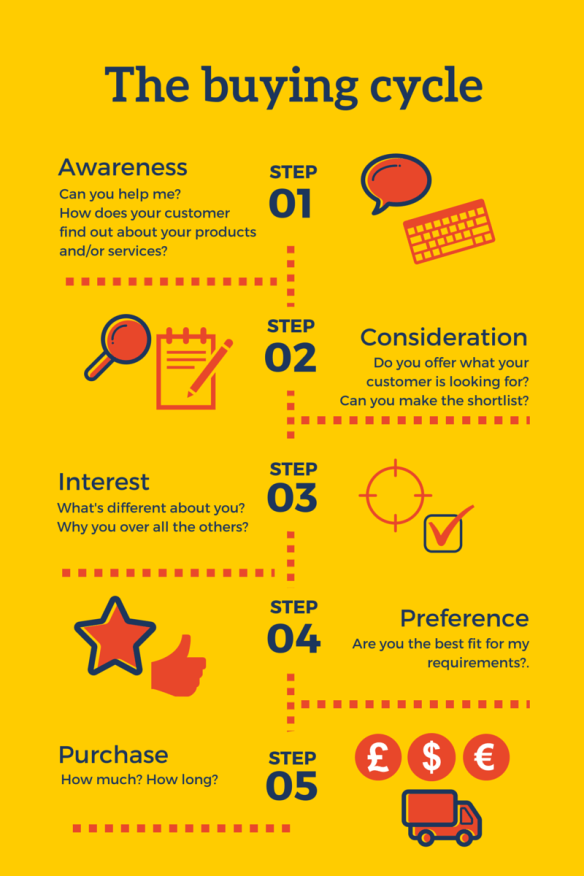
The purpose of creating your customer personas is to understand what you can do at every stage of the buying process to maximise the chance of your prospect choosing your product or service over all of the others that are available.
Getting to a clear definition of your the buying cycle for your product or service creates more questions than answers and this leads directly into the development of your customer personas.
5 – Drill down into the real detail
At every stage of the process outlined above there will be questions raised that will require a detailed understanding of your prospect’s behaviour in order to be able to increase the chance of success.
It is very rarely the case that you are selling to just one type of person. There may also be different products or services targeted at different groups. You need to create individual personas for each of these because ‘one size fits all’ is very rare.
Once you’ve identified the individual you are focusing on then you can work through every stage of the buying cycle and answer the questions that will help you to gain a much more complete understanding of their requirements at every stage.
Awareness
Where are they looking for information on your products or services. Internet research? Exhibitions or trade events? Trade magazines? Referrals from other customers? Do they already know us?
You can then drill down further into this – let’s take internet research as an example. The kind of questions you can ask here are;
- Desktop. mobile or tablet?
- Are they likely to click on Google AdWords? (typically around 30% of people will click on AdWords advertising)
- What time of day are they doing their research?
- How active are they on social networks? (and which networks do they use?)
- What industry sources do they use and trust?
Consideration
- What is the specific problem they have that they are trying to find a solution for?
- Who else will they be considering?
- Are they loyal to a particular brand at the minute and how long has this relationship been in place?
Interest
- What are the major pain points that they are trying to overcome?
- What is their reason for considering this purchase in the first place?
- How does what you offer meet their requirements better than anyone else?
Preference
You’ve been selected as the preferred supplier – but why?
Is it price, lead time, brand reputation?
Have you demonstrated experience in solving the kind of problems that this prospect has for others?
Are you the convenient choice? Is it because you are local (or have local support by way of a retail outlet or local distribution partner)?
What criteria has your prospect used to get to this point? Is it a tendering process where scores are given under a range of different criteria? If this is the case do you understand the scoring criteria and the weighting given in each area?
Purchase
What are the barriers to getting the sale closed? Are there terms and conditions to negotiate – will your payment terms be accepted?
Is this person the only person involved in the decision to purchase or are there others with an influence?
If there is more than one person involved in the purchasing decision you need to understand their individual motivations as well – so you go back to the start and complete the process again.
Once you’ve done this across your customer base and established customer personas for the key individuals you’ll find yourself with a lot more knowledge about your customers that will undoubtedly raise a whole series of questions about how your business manages the buying cycle.
If you’d like some help developing your customer personas then get in touch:
54.559300
-5.989477







 Petrac Marketing